The Largest Online Community for Contact Centre Professionals


The Largest Online Community for Contact Centre Professionals
 Close
Close



Published On: 6th Aug 2026 10:12
The language advisors use plays a key role in shaping customer experiences. Positive statements can support smoother interactions and encourage more engaging conversations.
They also offer variety, helping teams move beyond repetitive scripts. In this article, we explore 28 examples of positive phrases designed to increase customer satisfaction.
Here are some examples of positive scripting you can add into almost any customer conversation to boost customer satisfaction and offer advisors variety, so they are not constantly repeating the same phrases.
So the next time you are talking to a customer, use this list for inspiration to share with your team:
When beginning an interaction, it is customary to acknowledge the customer’s problem and then make a collaborative statement such as the one above.
Although this may sound generic, using words such as “delighted” or “happy” every now and then can be positive in terms of evoking an uplifting mood.
Starting a phrase with a word ending in -ly, such as absolutely, definitely or certainly, implies that you are agreeing with the customer and can therefore boost rapport.
This statement involves the customer using words like “we” and “let’s”, which encourages a collaborative environment that will improve the relationship between customer and advisor.
Using this phrase will help customers feel validated in their decision to phone the contact centre and reassures them that they were right to do so.
This encourages the caller that they have been put through to a helpful advisor who offers solutions instead of one who focuses on negatives.
Validating the customer’s opinion is something that advisors and often urged to do, in an effort to build rapport and consequently satisfaction. Often, advisors will use the quote above to do so.
Noting that others have also chosen the same solution implies that it is likely to be successful and has proven results, boosting customer trust in the brand.
Relaying positive feedback, casually and briskly, can reassure the customer of the quality of the product/service that is being discussed.
Again, referencing the success of the caller’s choice amongst other customers will encourage the customer, in terms of future results.
The statement above almost implies that the advisor is giving the customer inside information, which may boost a customer’s affiliation with the brand.
This is because the customer is likely to feel as though they have someone inside the business, rooting for their cause.
This statement assures the customer that there is a valid solution to their query and can create a customer-advisor connection, as the advisor is providing that insider information.
Using verbs such as “hoping” creates the impression that the advisor is actively supporting the customer from inside the company.
Providing the customer with a delivery date is a repetitive duty for most advisors in the contact centre, so here’s a few other positive ways of letting the advisor know.
Although this pushes the boundaries of being robotic, if used naturally it can allow the customer to feel appreciated, which may improve loyalty.
It may seem meaningless to state that your happy to help, as an advisor, but occasionally adding your positive thoughts can elevate the conversational tone.
Now that you handled the customer’s query, it is important to close the conversation positively to confirm any “good feeling”, which the interaction may have generated.
This reinforces the customer-advisor bond, but can sound unauthentic. So, make sure to use “I’m” instead of “I am” to maintain a sincere tone.
Personalising a statement is a great way to build rapport. Also, adding that you will pass on any compliments, at the end of this statement, will let the caller know that their voice is heard and appreciated.
Offering this may sound robotic, but it is common courtesy and most customers will likely appreciate the opportunity to voice any additional queries.
Repeating “I” in statements such as this demonstrates that the advisor is taking personal ownership of the issue and thus personally relieving the customer from the weight of their query.
Of course, the previous set of statements could only be used if the customer’s query was resolved successfully. After more difficult calls, the following statement could prove more beneficial.
Recognising that the call has consumed some of the customer’s time, as this quote does, can be a good addition to the conversation, so the customer feels valued and acknowledged.
This statement can lower your repeat contacts by establishing that the advisor has fully resolved the customer’s query.
This question helps confirm that the customer’s issue has been addressed. It also provides a clear opportunity for them to raise anything that may still be unresolved.
Sometimes an advisor will be left with no choice other than to make an apology. But when this happens, it’s better to say “my apologies” and take personal ownership, instead of “our apologies”, referring to the advisor and the company.
This expresses a polite closing sentiment and encourages the customer to reflect on their experience, opening the door for final feedback if needed.
This shows initiative and a willingness to go the extra mile, giving the customer a chance to raise any lingering questions or needs before ending the conversation.
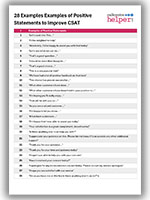
Do you want to download this to share with your team?
Get your 28 positive statements to increase customer satisfaction now:
Using the positive phrases above is a great way to start improving customer satisfaction, but there can be more to it when an apology is required.
Two of our readers have made great suggestions on what agents can do to improve satisfaction when an apology is required, but they are personally not at fault:
As a Call Centre Manager, my job is to keep my team happy as well as ensuring they are keeping our clients happy.
Team members having to apologise for something out of their control is demoralising and gives the client the upper hand. I want my team to feel that they are in control and at a minimum equal to the client on the other end of the phone.
They shouldn’t need to apologise, rather acknowledge that there is an issue, take ownership of it and address it. If they messed up however, definitely apologise and fix the problem.
Contributed by: Graham
I train call centre staff and always advise them to not apologise for the mistake made by someone else.
I get them to reframe the apology, making sure it comes from the company side.
Its not their personal fault, as that tends to drag them down, constantly saying sorry. and we lose staff who end up feeling low
Contributed by: Steve
Sometimes the agent talking to the client will be unable to resolve the issue, so what should they say in this situation?
To help we have put together two examples suggested by our readers on what phrases the agent can use when the clients issue has not been resolved:
Thanks you for calling (Company Name), my name is (Agent Name), how may I help to today?
Thank you for sharing your concern with me today.
I’m really sorry to hear that (mention issue), but don’t you worry you have me on the line, and I will do everything I can to help you to fix this.
(Customer Name), our service is complimentary if your issue is easy to fix, However if the issue is complex and requires advanced troubleshooting, we might offer you an alternative or you can to take advantage for our paid support.
We will perform a few troubleshooting steps to see if we can resolve this issue. Should your issue require more advanced troubleshooting to fix we can discuss other options and find the best solution for you. Is that okay?
(Customer Name), it looks like the issue is more complex and we need to perform advance troubleshooting steps that require to hold a remote session with your computer.
We’ll I can give options with our paid support service here at (Company Name) and then you can decide how you want to proceed. Are you okay with that?
The first option is our one-time premium support which will cover this issue. The cost of the service is $99 and if your issue is not fully resolved there will be no charge.
Our Premium Support also comes with a 30-day warranty should this particular issue reoccur in the near future.
Second option is our Support Plan which I recommend to all my customers since it has value for money.
It covers all product-related issues, and with this, you can also get free unlimited technical support training in a nearby store. Cost of this service is only $149 and it gives you complete peace of mind, 24/7.
Contributed by: Jane
Welcome to (Company Name) company name, my name is (Agent Name), how may I help you?
(Customer Name) you should look at the rules or instructions of your product. I will help you to understand what is going on with your product (computer , ticket, game, clock).
For example – If you what to change it you must give us a reason or it should be a product damage, but if you want we can fix it.
I’d be upset too if that happened to me. Don’t worry I’m going to check the options we can offer for you.
At this moment the systems doesn’t allow me to make any changes, but there are some options on what we can do next.
You can contact us by this telephone number because there are agents for this area, or if you prefer I can transfer this call.
Contributed by: Daniela
For more on using positive words in the contact centre, read our articles:
Reviewed by: Hannah Swankie

The Latest Customer Contact Research, Reports and White Papers straight to your inbox!
Get the latest insights from Call Centre Helper by signing up for our email content.
Close