The Largest Online Community for Contact Centre Professionals


The Largest Online Community for Contact Centre Professionals
 Close
Close



Published On: 5th Aug 2026 08:05
When navigating customer service conversations, clear and targeted questions are essential to uncovering customer needs and concerns effectively.
From initial greetings to understanding the heart of an issue, these questions help customer service teams dive deeper, show empathy, and find solutions tailored to each unique situation.
We have gathered examples of clarifying questions (open, closed and probing questions) that add value to customer service conversations.
Read on to discover 15 examples of clarifying questions and some tips on how and when to use them:
Often, this is the only open question that advisors need to use. It gives customers the space to introduce their query and vent. The question can, therefore, work well as part of a greeting message.
When a customer response is vague and offers few specifics to drill into, this question helps advisors skip ahead to the heart of the issue.
Understanding the extent of an issue guide advisors to an appropriate solution. Such a question may also encourage customers to open up and discuss the emotional impact it has caused. If they do so, advisors can show empathy and deliver better customer service.
When discussing a service issue, advisors may soon realize that a customer has selected a product/service that does not meet their needs. Asking questions like this helps advisors pair the customer up with a solution that suits them best.
When a customer calls to complain, collecting feedback to pass on to management may help to devise actions that will improve future retention rates. Open questions like this are great for gathering uninhibited verbatim feedback.
Discovering when a problem began is often critical to establishing a root cause. It also highlights how long the customer has been dealing with the issue. Such information may impact “next steps”.
Suggesting a solution that the customer has previously tried undermines the advisor’s expertise. So, if the customer indicates that they have attempted to solve the problem themselves, ask them what happened. Doing so may also provide some invaluable insights.
Probe into the steps a customer has taken to resolve the issue. Avoid passing judgement. Instead, listen to the logic of their actions, work together, and problem solve.
Open questions offer an outline of the customer’s problem. Probing questions add colour, allowing advisors to visualize the issue.
With such an understanding, advisors can link the query with previous experiences to find possible solutions.
Customers often give long-winded responses to open questions. A statement like this helps to focus the customer on the details that lead to a solution. Just be a little careful when starting sentences with “you”. Sometimes, it can seem accusatory.
Discover more excellent examples by reading our article: 17 Probing Questions to Improve Your Customer Service
Encourage advisors to paraphrase problems back to customers and ask this question. It reassures the customer that they were listening closely and fully understand the issue. Advisors may also check that they have not overlooked crucial snippets of information.
Miscommunication is often the result of customers changing their contact information without informing a company. Such a closed question can quickly troubleshoot this issue.
Long periods where customers wait on hold while advisors look for information can lead to customer frustration.
To better bridge silences, offer a callback – with a time expectation – so the customer can continue with their day.
When a customer seems unsure about the progress of their call, offer them the chance to speak up. Doing so ensures that they feel heard. When dealing with vulnerable customers, this is especially important.
After solving a query, asking if the customer would like any extra support helps avoid a second call and is considered a common courtesy. Just be careful about using this question when the original issue has not been resolved.
Do you want to download this to share with your team?
Get your free download of 15 Clarifying Questions Examples now:

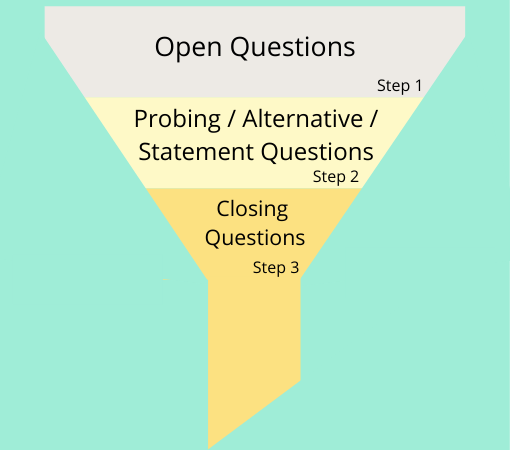
When handling a call with no obvious process to follow, “The Funnel Effect” is an excellent technique to focus the conversation on a tangible solution.
The significance of this technique is that it encourages advisors to use a combination of open, probing and closed questions – in that order.
Indeed, the advisor starts with an open question to understand the issue. They then clarify the situation and ask a probing question to focus on specifics. Finally, they use closed questions to either confirm their understanding or move the conversation along.
As such, a call follows a flow as highlighted in the diagram below.
Open questions, such as “how,” “when,” “where,” and “what,” encourage customers to express their concerns in detail. This approach not only gathers essential information but also makes customers feel valued.
Advisors can enhance these interactions with verbal nods like “I see” to build rapport. However, questions beginning with “why” can make customers defensive and sour the conversation, so it’s best to avoid them.
Probing questions help advisors dig deeper into a customer’s issues. According to Sara Odorisio from Hodos Training, “If an advisor is ever unsure of the reasons and emotions that are driving a call, they can use probing questions to discover more.”
Active listening is crucial here, as it allows advisors to tailor their questions effectively.
Closed questions typically begin with “do,” “could,” “is,” “have,” or “what,” limiting responses to simple yes or no answers. These questions help keep conversations on track, especially when customers are rambling. While useful, these questions should always stay relevant to the situation at hand.
Consider the following conversation as an example of how the Funnel Effect works in practice.
The advisor begins the conversation with an open question. They then delve into the specifics of which details the customer wishes to change. Finally, the advisor dives into the heart of the matter with a closing question.
When using the technique, Sara Odorisio stresses that advisors avoid stringing questions together, instead recommending a “question, answer, comment” approach.

“Ask one question at a time,” she says. “Some advisors will ask two or three questions at a time, which is confusing as the customer doesn’t know where to begin their response.”
“Instead, coach advisors to ask one question, listen closely to the answer and reflect on the customer’s response with a comment before asking another question.”
Training advisors to refer back to the customer’s answer – perhaps by paraphrasing it and reflecting particular keywords – encourages them to listen more closely to customers.
Good questioning is central to excellent customer service. However, asking customers question-after-question can feel like an inquisition.
Of course, sometimes asking lots of questions is unavoidable. In these incidences, encourage advisors to introduce their questions with a friendly bridging message. Customer Service Specialist Myra Golden recommends the following statements:
Using one of these statements helps to bridge into the questioning. Doing so removes the sense of being under interrogation from the customer’s mind.
If advisors also use common courtesies, such as “please” and “thanks”, they can create an even more pleasant experience.
For more examples of clarifying questions, read these articles next:
Reviewed by: Robyn Coppell

The Latest Customer Contact Research, Reports and White Papers straight to your inbox!
Get the latest insights from Call Centre Helper by signing up for our email content.
Close