The Largest Online Community for Contact Centre Professionals


The Largest Online Community for Contact Centre Professionals
 Close
Close




Published On: 6th Aug 2026 08:00
We explore how to improve internal communication across an organization, with lots of ideas, real-life examples and mistakes to avoid.
In a recent poll, we found that a lack of communication between departments was by far and away the biggest barrier to making customer experience easier.
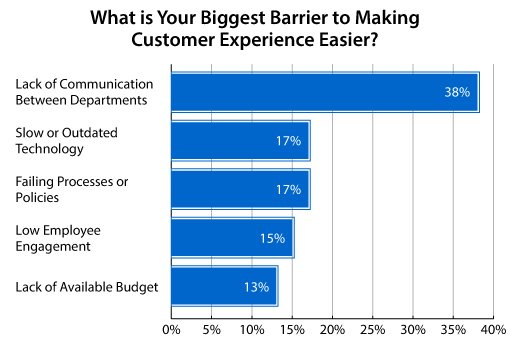
When there is a lack of communication between departments and the contact centre especially, lots of great customer insights go unnoticed.
To help solve this issue and improve internal communication, we have some great solutions below that – when implemented well – can work wonders in improving customer experience.
“One of the suggestions I always make, particularly if communication is severely lacking, is a comms charter so people understand what they need to do, when and how – expectations are clear and there is accountability,” says Helen, Founder of Unique & Inclusive Wellbeing.
By laying things out in writing, we can clarify our organization’s goals and objectives, while setting commitments regarding how different departments work together and how often they update one another.
A good communications charter will be made up of many different elements, with three key components:
Once everyone understands what is expected of them – in terms of objectives, strategy and time commitments – you can look at how you can improve the flow of information between departments.
Now that you have an outline as to what should be included in your communications charter, let’s take a look at some other ideas for improving communication across your organization.
Ideas six and seven are a little more adventurous in terms of your strategy to improve internal communications, and we saw these strategies be successful at the MOO and Gousto contact centres, respectively.
Communication can often be blighted between business departments due to the fact that email can be a channel that stifles collaboration.
Yet what are the alternatives? It can be hard to reach another department head via phone call, and setting up a group conversation can be time consuming.
So, if your organization has its own intranet system or community group, having a separate channel for collaboration can be a great alternative – if everyone buys into the idea.
The key benefit of this is that a system like this removes those long email chains, as Katie Bunting, a Senior Internal Communications Manager at OVO Energy, once told us.

“When email was our main channel for internal communication, employees received lots of emails that completely distracted from the messages that we really wanted to get across… it was not the ideal place to share important information,” said Katie.
“So, across the business, we moved to Google and utilized Google communities. This allowed us to segment communications so that other departments, like HR, could easily communicate with the entire contact centre team in their designated space.”
A simple alternative, which we found during a site visit to the PhotoBox contact centre in London, is to create spreadsheets with certain departments that contact centre advisors are encouraged to write on.
These spreadsheets were used to gather customer feedback on new marketing initiatives and product designs, which can be accessed by the relevant departments.
Many times, despite your best efforts, you just can’t get much face-to-face time with other department heads. Maybe a video call every once in a while, if you are lucky.
The most obvious tactic to improve internal communication in this scenario is to make the most of the time that you do get.
For example, to prepare for your rare meetings, you can:
When preparing for these meetings, just remember that there is nothing worse than a meeting where other people feel as though they are there to justify what they have been doing. It be should be an open discussion, where everyone feels comfortable in speaking up.
With that being said, your meetings should have a clear purpose. Just make sure that you listen to everyone’s thoughts before making decisions. Don’t go into a meeting looking to force people into your way of thinking.
For more on what to include in your team meetings, read our article: What to Include in Your Daily Briefing Sessions or Virtual Huddles
Don’t think of knowledge management as an insular activity, think of knowledge sharing instead.
Many contact centres have a knowledge base and just think: how can this support our advisors? But why not think about how it can help other departments and customers too.
While you may, in the contact centre, think ‘what’s in it for us?’, over time – with access to your knowledge base – other departments will realize what a great source of customer insight the contact centre is.

“Stop and acknowledge what the purpose of the knowledge is. In the context of a contact centre environment, knowledge is very much aimed at satisfying what customers want,” adds Peter Massey, MD at Budd.
If you are creating material based on “satisfying what customers want”, then that will be of value to other departments, which share that very same goal.
Also, give other departments the chance to contribute to the knowledge base too – as the contact centre isn’t the only place that stores great information. Just ensure these knowledge contributions are reviewed in terms of usability.
Instead of asking other departments what they can do to help you, think about how you can help them. What knowledge do you have that can support them?
Of course, this requires an understanding of how they operate. Hopefully, as the manager, you will already know this, but if not, there are many ways to learn.
While setting up these initiatives may be easier said than done, if you tell them that you are looking for opportunities for where you can better support them, why would they say no?
By supporting other departments, not only are you removing key friction points in the customer journey, over time, better processes may lead to lower customer complaints.
Also, if you can make the initial move in generating goodwill, other departments will likely be happier in supporting you when you come to them with ideas for how they can help the contact centre.
A gesture of goodwill is always a nice way to develop a good working relationship and can help to build the contact centre’s prominence within the business.
An example of such a goodwill gesture is taking a lead role in organizing company-wide events and ensuring that people within the departments mix well with one another.
By taking the reins of projects like this, you can help to minimize “office tribalism”. Office tribalism can be a problem because when a person is only focused on their department, their ability to collaborate with others deteriorates.

Also, if we can bring different departments together, we can help to remove industry stereotypes, like IT teams are “the geeks” and designers are “the hipsters”.
So, taking the reins of an industry event is one way to promote goodwill and lay the foundations for building positive business results, but you could also:
By taking the lead role in these “goodwill gestures”, you will encourage more positive business relationships and build the enthusiasm in others to better support your department.
For more simple but effective ideas like this, read our article: 5 Ways to Improve Relationships Between the Contact Centre and Other Departments
This initiative involves giving one or two contact centre advisors the interim non-official title of “customer experience liaisons”, and having them work closely with other departments, working on new services, products and features.
Creating customer experience (CX) liaisons was a success for MOO, the online print and design company, as it benefited both the wider business and the contact centre.

According the Dan Moross, Customer Experience Director at MOO, the initiative benefited the wider business because the CX liaison, being a customer service advisor, was able to provide Voice of the Customer (VoC) feedback to each department.
For example, if working with the product design team, the CX liaison could pass on information, such as:
So, the CX liaison is representing the customer and the contact centre, while passing on valuable feedback.
Secondly, this initiative benefits the contact centre as the liaison gets the opportunity to take back all of the things that they saw happen in their working group to the contact centre.
Everyone who is on the phones, chat or on email therefore knows what is going on elsewhere in the business and that can be discussed in a group.
This initiative therefore allows MOO’s contact centre to prepare for future changes that may impact the contact centre, such as identifying new training needs and FAQ content – for example.
To hear more from Dan, listen to the following episode of The Contact Centre Podcast, where he discusses what MOO have been doing to create a great company culture.
The Contact Centre Podcast – Episode 2:
For more information on this podcast visit Podcast: How can you create a happy culture of positive people?
This initiative involves designating an advisor to work alongside a specific department. The advisor becomes a specialist in this area and acts as the go-between the contact centre and the department to which they have been assigned.
These departments may include:
The advisor would be responsible for finding out what is going on in their given department, thinking about how that might impact the contact centre and updating management.
Again, the advisor would also help to support these other departments, by conducting Voice of the Customer (VoC) research, using contact centre insights, to help inform their decision-making.
Gousto’s contact centre in London asked their Subject Matter Experts also to identify improvement opportunities and be a part of their implementation. They are asked to ensure the internal and external knowledge base content is relevant and up to date as well.
For more tips from Gousto, read our article: 20 Award-Winning Tips from the Gousto Contact Centre
Here are five traps which are easy to fall into, which can play a big part in holding your organization back from achieving great internal communication.
1. Personal Conflicts – A minor disagreement between two department heads can disrupt the entire workflow within a company and limit collaboration.
To help avoid such personal conflicts, be the mediator. When they need to communicate, make sure you are kept in the loop, so they can collaborate without dealing directly with one another – if needs be.
2. Office Tribalism – Communicating with other departments wasn’t a key part of your job description. It said that your key focus was your department – so that must take precedence, right?
This kind of thinking leads to office tribalism. We need to safeguard ourselves from taking this stance and take the time to consider how we can work with other departments – for the benefit of everyone.
3. Doing Everything Via Email – With email, important messages can slip through the cracks and collaboration may cease to be an immediate priority.
By having a separate channel for business communication, which everyone commits to keeping up to date in the communications charter, you can better ensure that working together remains high on the agenda.
4. Jumping to Conclusions – We can often jump to conclusions regarding how different departments operate and make suggestions that aren’t practical.
So, take the time to learn how other departments work, before suggesting how your customer insights might benefit them.
5. Keeping Collaboration Informal – The best way to break negative habits – such as poor internal communication – is to establish routines.
So, when you arrange meetings or other collaboration activities, get them scheduled into the diary. And, when you decide on a plan of action, schedule follow-ups to ensure that progress doesn’t fall by the wayside.
Internal communication impacts your business in many different ways, including:
Each of these outcomes makes a clear case for improving internal communication within your organization – an activity in which the contact centre should take a starring role.
After all, the contact centre is the home of great customer insight that can really help to positively influence key decisions made in other departments.
In addition, there is lots that other departments can do to help out the contact centre too, in terms of reducing failure demand.
So, why not start with some of the ideas presented in this article? Then, over time, you can work your way up to implementing great strategies to improve internal communication, like having customer experience liaisons and subject matter experts.
If you are looking for ways to improve internal communication within the contact centre itself, read our articles:
Reviewed by: Megan Jones

The Latest Customer Contact Research, Reports and White Papers straight to your inbox!
Get the latest insights from Call Centre Helper by signing up for our email content.
Close