
The Largest Online Community for Contact Centre Professionals


The Largest Online Community for Contact Centre Professionals
 Close
Close




Published On: 5th Aug 2026 07:58
The success of a call centre depends on a well-coordinated team of specialists, each playing a crucial role in optimising operations and enhancing customer satisfaction.
Here are job overviews and job descriptions for all call centre roles, from a Call Centre Agent to a Customer Service Director.
Within a call centre there are common roles, responsibilities, and positions, including the Call Centre Manager, Team Leaders and Agents.
There are also other call centre job titles, such as the Customer Service Director, Resource Planning Analysts and Quality Analysts, all of whom play a vital role in helping the contact centre meet its targets.
A list of typical call centre positions is provided below:
Understanding each of these roles could come in useful when trying to set up a call centre, or just to familiarize yourself with the industry.
Yet many call centres won’t have personnel in each of these roles. The size of the centre will determine the available positions, as well as the number of Team Leaders and additional support positions.
For more of the basics regarding the make-up of a call centre, read our article: What Is a Call Centre? – 10 Things to Know
The following organizational hierarchy shows the typical structure and positions within the call centre.
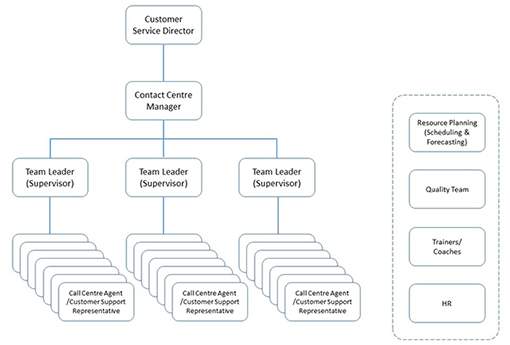
Below, we share job descriptions for most of the roles introduced in this flow diagram – with additional job introductions for the other call centre positions.
A Call Centre Agent can be known by various titles, depending on the responsibilities of their position within the call centre, these titles include:
To find out more names and titles for call centre agent positions, read our article: What Other Job Titles Should We Call Centre Agents?
Here is a video in which we introduce you to the role of Call Centre Agent. The video is narrated by Hannah Cox of Douglas Jackson – the contact centre recruiter.
If you are looking for a job description for a Call Centre Agent in the more traditional format, take a look at our example below.
A Call Centre Agent is generally expected to solve queries when a customer phones into a contact centre.
However, an Agent may also contact customers themselves, maybe for customer research purposes or perhaps to sell them something.
In addition to phone calls, Agents often communicate with customers via email, live chat or post – or “snail mail”, as it’s frequently referred to.
Agents are often referred to by other names, including Agents, Customer Service Representatives and Associates – so if you are interested in becoming a Call Centre Agent, make sure you look out for job descriptions with these titles too.
If you work as a Call Centre Agent, your day-to-day activities may include:
You may also be expected to take on responsibilities like:
The top three skills that recruiters tend to look for in a Call Centre Agent are:
Other skills that make up a good Call Centre Agent include problem-solving, collaboration, patience, tech-savviness and the ability to socialize well.
Find more skills that call centres value in an Agent in our article: The Top 10 Most Important Customer Service Skills
A background in a customer service environment will be very desirable, and this doesn’t have to be in a call centre environment. You may also need GCSE passes in Maths and English.
If you are from the US, you may need a minimum of a high school diploma.
Here is a video in which we introduce you to the role of a Call Centre Team Leader. The video is narrated by Hannah Cox.
If you are looking for a job description of a Call Centre Team Leader in the more traditional format, take a look at our example below.
Are you still not sure on the difference between a Manager and a Leader? Check out the following article to find out for sure: Are You a Manager or a Leader?
A call centre Team Leader has the responsibility of managing a team of Call Centre Agents. The numbers usually range between eight and twelve.
If you work as a call centre Team Leader, your day-to-day activities may include:
You may also be expected to take on responsibilities like:
The top three skills that recruiters tend to look for in a Call Centre Team Leader are:
Other skills that contact centres will look for in terms of a call centre Team Leader include being customer focused, employee focused and having a good understanding of basic HR guidelines.
Team Leader positions will normally require people with management experience in a contact centre environment.
Experience in a contact centre environment may be more important than qualifications once we get to this level of role.
How a Team Leader spends their time will vary greatly from one contact centre to another. While this mostly comes down to culture, it also comes down to the size of the team they’re leading.
The number of agents in a contact centre team is not consistent across the industry, as highlighted in the graph below, which has been taken from a 2019 Call Centre Helper report.
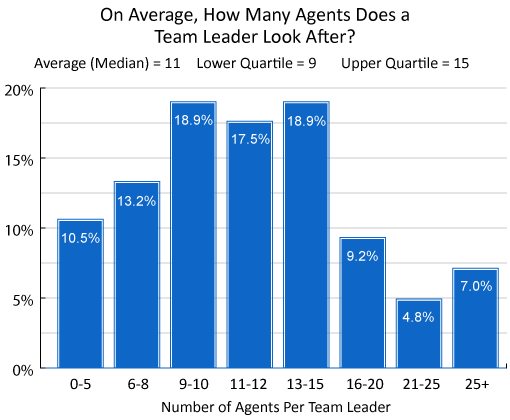
As you can see, many contact centres reported team sizes of less than six Agents, while others had over 25 Agents per team. That’s a massive 19 head difference.
Generally, those with fewer agents in a team will invest more in creating relationships to improve the Agent experience and, in doing so, the customer experience.
However, those contact centres who opt for larger team sizes will do so in order to boost efficiency, as Team Leaders will be expected to take on more administrative responsibilities.
Find out how to be the best possible Team Leader in our article: Team Leadership: What Makes a Great Leader?
Here is a video in which we introduce you to the role of a Call Centre Manager. The video is narrated by Hannah Cox.
If you are looking for a job description of a Call Centre Manager in the more traditional format, take a look at our example below.
A Call Centre Manager has the responsibility of managing a group of Team Leaders, who then have teams of Agents reporting to them.
If you work as a call centre Call Centre Manager, your day-to-day activities may include:
You may also be expected to take on responsibilities like:
The top three skills that recruiters tend to look for in a Call Centre Manager are:
Other skills that contact centres may look for in terms of a Call Centre Manager include being people focused, performance driven, and having a solid understanding of basic HR guidelines.
Find more skills that recruiters look for in a Manager in our article: 10 Essential Skills for Every Contact Centre Manager
Contact Centre Manager positions will normally require people who have experience of managing Leaders in a contact centre environment.
The relevant experience in a contact centre environment may be more important than qualifications for this level of role.
Here is a video in which we introduce you to the role of a Customer Service Director. The video is narrated by Hannah Cox.
If you are looking for a job description of a Customer Service Director in the more traditional format, take a look at our example below.
A Customer Service Director has the responsibility for defining the strategy for a customer service operation, and then creating a shared vision to enable the effective delivery of that strategy. (Note, there is also a new Chief Experience Officer (CXO) role in the mix as another option for career progression.)
If you work as a Customer Service Director, your day-to-day activities may include:
You may also be expected to take on responsibilities like:
The top three skills that recruiters tend to look for in a Customer Service Director are:
Other skills that contact centres will look for in terms of a Customer Service Director include being people focused, driven, emotionally aware and resilient.
A Customer Service Director role will almost definitely require a proven track record of delivering results at a senior level within a desirable business or industry, having achieved similar outcomes that the new business is looking to achieve.
For more on this role, read our article: Customer Services Director: Example Job Description
Here is a video in which we introduce you to the role of a Resource Planning Analyst. The video is narrated by Hannah Cox.
If you are looking for a job description of a Resource Planning Analyst in the more traditional format, take a look at our example below.
A Resource Planning Analyst’s role within a call centre is to make sure that the right people are in the right place at the right time.
If you work as a Resource Planning Analyst, your day-to-day activities may include:
You may also be expected to take on responsibilities like:
The top three skills that recruiters tend to look for in a Resource Planning Analyst are:
Other skills that make up a good quality Resource Planning Analyst include problem-solving, collaboration, being technology savvy, and able to communicate well at all levels.
A background in customer service and contact centres is desired for this sort of role, and Resource Planning Analysts have often previously worked on the phones as call centre Agents.
Advanced Excel training and qualifications in mathematics or statistical-related subjects may be beneficial.
If you want to be a good Resource Planning Analyst, you’ll need to understand all of the concepts that are presented in our article: Workforce Planning: 20 Fundamental Rules
Here is a video in which we introduce you to the role of a Call Centre Quality Analyst. The video is narrated by Hannah Cox.
If you are looking for a job description of a Call Centre Quality Analyst in the more traditional format, take a look at our example below.
A Call Centre Quality Analyst monitors and assesses the quality of customer conversations, across all contact centre channels. This includes phone calls (both inbound and outbound), emails, live chat conversations and so on.
In doing so, a quality analyst is tasked with the wider goal of supporting advisors to improve their customer interactions.
If you work as a Call Centre Quality Analyst, your day-to-day activities may include:
You may also be expected to take on responsibilities like:
The top three skills that recruiters tend to look for in a Call Centre Quality Analyst are:
Other skills that contact centres will look for in terms of call centre Quality Analyst include quality focused, an ability to work to tight deadlines and being technology savvy.
Call Centre Quality Analyst positions will normally require people with contact centre experience.

Contact centres usually recruit Quality Analysts internally, promoting experienced and driven advisors who are familiar with the current quality programme and wider organizational goals.
Having basic level GCSEs may help, particularly in Maths and English. If you are from the US, you may need a minimum of a high school diploma.
To find out more about what Quality Analysts do, read our article: Contact Centre Quality Assurance
Contact Centre Heads lead contact centre operations of various sizes. Typically this is a fast-paced area of business that is challenging and changing continuously.
Someone in this position would be expected to shape the future of the contact centre operation, to improve the customer experience through each available channel.
Typically, the Head of the Call Centre would report to the Customer Services Director or Managing Director and would be held accountable for the performance of all call centre teams.
Yet there is much more to the role, as highlighted in the duties listed below.
For more on this role, read our article: Head of Contact Centre: Example Job Description
This role is primarily responsible for the uptake of digital channels and customer contact efficiency across digital service lines.
Furthermore, it is the responsibility of the Digital Contact Director to deliver a service that does not compromise existing revenue, service and margin position.
Also, it is up to the person in this role to lead the creation/development of a digital contact strategy, researching, proposing and designing the correct digital channels that match brand image and ambitions.
For more on this role, read our article: Digital Contact Director: Example Job Description
A new role for the Call Centre is the Chief Customer Officer.
The CCO reports on the critical customer outcomes and brings relevant trends to the attention of Customer Experience executives and CEO.
They create the CX strategies working with other departments to meet CX goals and have a overview of metrics such as Customer Effort, NPS etc.
As a support role in larger centres, the Operations Manager would tend to look after the operational elements of the contact centre.
A person in this role would also be expected to liaise with the Team Leaders and the Call Centre Manager regarding performance management information, and they would usually be the link with the IT department or technology suppliers.
So an Operations Manager would have to be good with statistics and technically minded, while communicating with all levels of the contact centre.
For more on this role, read our article: Senior Operations Manager: Example Job Description
Customer e(X)perience Officer (CXO) doesn’t have to think about the customer experience in his or her spare time from their “other” C-level responsibility, but is devoted 100% to CX.
By definition, the C in CXO stands for customer. The entire focus of the CXO is on customers, and CX programmes and initiatives. If anything, the CXO can be the common thread woven through and across the entire company — including any potential silo department.
For more on this role, read our article: What is a CXO? The Chief Experience Officer Explained
There needs to be a very close relationship between HR and the call centre due to HR’s ongoing people activities such as recruitment and training.
Depending on the company, there may be HR resources within the call centre.
Usually HR are responsible for ensuring that terms and conditions of employment and job descriptions are all in place, as well as organizing recruitment and possibly training for the call centre. They also deal with issues that individuals may have personally or professionally.
Some centres have trainers as part of the overall team because of the high volume of induction and ongoing training that is required.
They are responsible for preparing and delivering training to the agents in the centre.
In larger centres, in addition to the Team Leader, each team may have a coach who will provide additional support and technical knowledge to the agents.
This is usually someone who has been a very good agent and has a good way of getting information over and helping someone to improve their performance.
Thanks to Douglas Jackson for their help with this article.
If you are looking for a new role within the call centre industry, these articles may be helpful:
Reviewed by: Hannah Swankie

The Latest Customer Contact Research, Reports and White Papers straight to your inbox!
Get the latest insights from Call Centre Helper by signing up for our email content.
Close