
The Largest Online Community for Contact Centre Professionals


The Largest Online Community for Contact Centre Professionals
 Close
Close




Published On: 6th Aug 2026 08:00
Customer service activities are a great way to bring energy, focus, and creativity into your team’s day-to-day work. They don’t need to be time-consuming or expensive to make a real impact.
In this article, we share ten simple and engaging activities that you can use to inspire great service in your contact centre.
Our ten customer service activities include a mix of short and sharp, periodical and cultural activities, designed to improve different aspects of your customer service.
Many of these activities require little to no planning or expensive resources and will help you when you feel like you need to inject some energy into your team or want to illustrate a particular point.
Each of these activities has been suggested to us by Caroline Cooper, an experienced contact centre trainer and founder of Naturally Loyal.
We hope you find them practical to use in your contact centre!
Encourage your team to take the initiative in everyday interactions by greeting service staff warmly and proactively, even outside of work.
Set your team a challenge: the next time they’re shopping or speaking with a shop assistant, they should make the first move by offering a warm, friendly greeting.
Often, this small act of enthusiasm is enough to spark a more positive exchange – and even if it doesn’t, it offers valuable practice in building rapport skills.
This activity can be done in everyday situations, while out with family, during a coffee run, or even at the bus stop. “They could practise this when out socializing with family and friends or even with someone (socially distanced) at the bus stop,” suggests Caroline.
Be sure to schedule a follow-up session a few days later so the team can reflect, share their experiences, and discuss what they learned.
Send your team out into the world as “mystery shoppers” to explore what other businesses are doing well, and gather inspiration to improve your own customer experience.
Challenge team members to visit any retail store, coffee shop, or service setting, it doesn’t have to be in your industry.
Their mission is to return with at least three customer service ideas that could be adapted and applied in your own business.
Keep the brief focused, and schedule a structured virtual session afterward where everyone can share their findings.
You don’t need to send the whole team out at once, and you might offer a small incentive like an extended lunch break or early finish on the day of their visit. If needed, consider covering small expenses like the cost of a coffee.
Rotate team members into different roles within (or outside of) the contact centre to keep things fresh, promote collaboration, and support personal development.
Contact centre work can become repetitive, so giving advisors the opportunity to temporarily swap roles helps keep them engaged and motivated.
These swaps – even if only short-term – give staff insight into other areas of the business and may spark interest in future career development.
Where possible, rotate roles across departments to promote a better understanding of the wider operation.
You can also consider bringing people from outside the contact centre in for a day or two – this helps them understand the strategic value of the advisor role, especially in a remote environment.
Turn refresher training into a lively, interactive experience by hosting a virtual team quiz, making learning feel more like fun than a chore.
Instead of delivering the usual refresher training session, run a quiz to test your team’s knowledge in a more engaging way.
Quiz questions can cover everything from quality scorecard criteria to company policies or knowledge base navigation. For example:
For added involvement, ask team members to create the questions themselves, either individually or in small groups, and quiz each other.
For more contact centre quiz ideas, read our article: 3 Ways to Have Fun in the Contact Centre
Put your team in the customer’s shoes by asking them to reflect on their own experiences of great, and not-so-great, service.
Start by asking advisors to share personal examples of customer service they’ve loved or loathed. In pairs or small groups, they’ll discuss real-world experiences outside of your business and identify what made each one stand out (for better or worse).
Have each group share one or two examples. Note these down on a visible flipchart or virtual whiteboard split into two columns: “Love” and “Loathe.” Then, prompt the team to consider: how many of these apply to our own business?
Next, ask them to score the business on a scale of 1 to 10:
Finally, choose one item from each list and brainstorm ways the team could either strengthen that positive aspect or improve where things fall short.
Start each day with a quick, energetic team huddle, known as a “buzz briefing”, to set the tone, share updates, and build customer service momentum.
Buzz briefings are short, focused team meetings (which can easily be done virtually) that help kick off the day with purpose and positivity. Use this time to:
Keep it brief, upbeat, and team-led where possible, standing huddles work well to maintain energy.
Caroline Cooper adds: “One great addition to these briefings is to focus on one aspect of customer service you particularly want the team to pay special attention to. This helps to put the focus back on the customer.”
Turn a service-related problem into a constructive learning opportunity by helping your team understand what they can, and can’t, influence in customer interactions.
Use your next buzz briefing or virtual huddle to walk through this simple, collaborative activity:
Exceptional service begins with a shared vision, one that clearly expresses how you want customers to feel when they interact with your business.
If you don’t already have a service vision in place, involve your team in creating one. Start with a virtual meeting and ask: How would you like customers to feel after doing business with us?
Capture everyone’s responses using their exact words. Then, group similar terms and divide them among smaller breakout groups.
Each group’s task is to define the actions and behaviours that would help create those customer feelings, for example, what would you need to do or say to make a customer feel “valued” or “understood”?
In the second part of the activity, bring the focus to the individual level. Ask each team member to reflect and answer:
Encourage advisors to display their personal vision at their desks or in their virtual workspace as a daily reminder of their role in shaping the customer experience.
For more on the topic of customer emotion and its growing influence on the contact centre industry, read our article: 7 Steps to Evoke the Emotions You Want From Your Customers
Empower your team by nominating “Service Champions” – individuals who take ownership of specific areas of the customer experience, using their strengths to lead by example.
Nominate team members (or better yet, invite them to apply) to become champions for key aspects of your customer experience.
These could include specific products, service channels like social media or complaints, different customer segments, or even distinct stages of the customer journey.
Champions act as the go-to experts in their chosen area. They lead discussions in team meetings, contribute ideas for improvement, and support new hires during onboarding.
While they don’t replace broader team contributions, they help bring focus, depth, and accountability to their specialist subjects.
The role is also a great development opportunity. It gives advisors a chance to build confidence, share best practices, and feel recognised for their strengths.
Sometimes the most powerful motivator is also the simplest: a genuine “thank you.”
Make it a habit to regularly acknowledge and appreciate good performance. Whether it’s completing a difficult task, going the extra mile for a customer, or simply showing up consistently with a positive attitude, a timely and sincere “thank you” can go a long way.
Recognition doesn’t always have to come from leadership. Encourage peer-to-peer appreciation too. Team members can nominate each other for small rewards or shout-outs in team meetings or chat channels.
If you want to go a step further, tie appreciation to a small reward that benefits both the individual and the wider team, like attending a Call Centre Helper webinar or joining a virtual session with another department to share insights.
What matters most is that the appreciation feels authentic and timely.
For more reward ideas that are a bit more fancy than saying “thank you”, read our article: How to Improve Your Employee Reward Schemes – With Examples
Not content with collating these ten fun customer service activities, we wanted to find out more about how we can create an enjoyable contact centre environment.
So, we got in touch with Sunny Sandwell, Director of Fun at Work, who told us: “There is lots of evidence to suggest that businesses who take proactive steps to better engage their people outperform their competitors that don’t.”
With this in mind, Sunny shares her five keys for inspiring fun in the contact centre.
Appoint an In-House Fun Expert – Having someone that will encourage competition between different teams and coordinate the activities will help to add structure to the fun and make sure it doesn’t fall by the wayside. It is best for this to be an advisor, who can get their colleagues invested in the activities.
Encourage People to Move Around – We want people to be active on their breaks and even in between calls, so they can get energized and they don’t spend their time switching from their desktop to their phone – screen-to-screen. So, start a most steps competition or set daily challenges to encourage physical activity from remote advisors.
Add Some Healthy Competition – When doing activities, like a virtual team quiz, look to include other departments to encourage collaboration and break down silos between everyone. If we add a little edge with a trophy or similar reward, we can add a competitive spirit between the teams as they work closely together.

Don’t Force the Fun – If certain advisors don’t want to take part in certain fun activities, don’t force them – unless the customer service activities are mandatory for training. They will still benefit from having a lively virtual atmosphere and enjoy listening to people having fun.
Create a Calendar of Fun Activities – Alongside your mandatory customer service activities, have a calendar of activities that people can dip in and out of. This can include anything from the activities highlighted above to well-being exercises, such as virtual laughter yoga and inspirational talks.
With most advisors now working from home, we don’t want them to feel isolated from the fun culture that we are aiming to achieve with these customer service activities. Doing so will not only damage morale, but it may begin to show in performance statistics.
We therefore want to keep remote advisors engaged with what we are doing in the contact centre and even make sure that they have similar activities to keep them motivated.
To do this, we asked Sunny to share with you the following set of customer service activities, designed specifically for remote advisors.
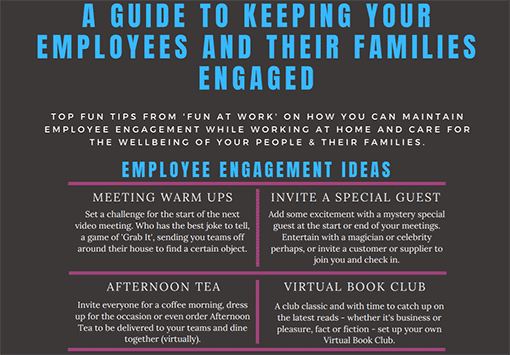
In the image above, we can only see a small taster of the many great exercises that Sunny has put together.
To see all of the other ideas, click on the image and download the full version.
To help solve the other challenges of homeworking, like keeping remote advisors engaged, read our article: 15 Contact Centre Homeworking Problems and How to Overcome Them
If you want more fun customer service activities to improve contact centre performance, read these article next:
Reviewed by: Hannah Swankie

The Latest Customer Contact Research, Reports and White Papers straight to your inbox!
Get the latest insights from Call Centre Helper by signing up for our email content.
Close