
The Largest Online Community for Contact Centre Professionals


The Largest Online Community for Contact Centre Professionals
 Close
Close




Published On: 6th Aug 2026 12:20
To be inspiring in a credit crunch is a big ask for any manager. However, it is not an impossible ask.
There are several elements to inspiring others. Gwenllian Williams explores how…
‘Tell a man where he is going and he will march faster’ is an old saying which applies to all management.
There is nothing worse for any employee than to feel as though they are in a business with no direction, no future and no clear vision.
People are inspired by management who set challenging goals, have a clear plan for how to achieve the goals and also set clear expectations of people in moving towards those goals.
Without this communication, people tend to gravitate to doing the easy thing because that, at least, feels like something useful.
When setting a vision and a path, managers need to include all employees – being asked for an opinion is inspiring in itself and seeing your ideas being taken up by management is highly motivating.
Having set the vision, it needs to be fully communicated and everybody motivated by understanding their role in reaching the vision.
There is a school of thought (Maslow’s hierarchy of needs) which states that ‘self-actualisation’ is the strongest motivator.
‘Self-actualisation’ is the psychological term for the feeling that you are getting somewhere, advancing, developing and can get to the next level. In business terms this often means ‘ambition’.
Obviously, every business will have a certain percentage of employees who do not have a bone of ambition in their whole body.
However, managers should assume that the vast majority are interested in getting on and moving up. Lack of career path literally inhibits or frustrates ambition.
An inspiring business will have clear career paths for every department which set out the activity expectations at each level and the skills required to deliver those activities well. These career paths are often set out in a competency framework or talent management process.
Whichever it is, it needs to be well communicated and used to progress people as they actively develop their capability.
In businesses where it is hard to develop an upward career path (Call centres often have difficulty here) then the career path needs to encompass broadening in which employees learn new activities and new skills by moving from one part of the business to the other.
Another aspect of ‘self-actualisation’ is the extension of skill through training and development. Training needs to be more than a delivery of ideas and techniques; it needs to inspire people to do things differently back in the office and to have the confidence to try something new and better.
This is no mean feat and largely depends on the content of the course and the style of the trainer.
A few tips for ensuring inspiring training in your business are:
A model that we use, covers the key elements:
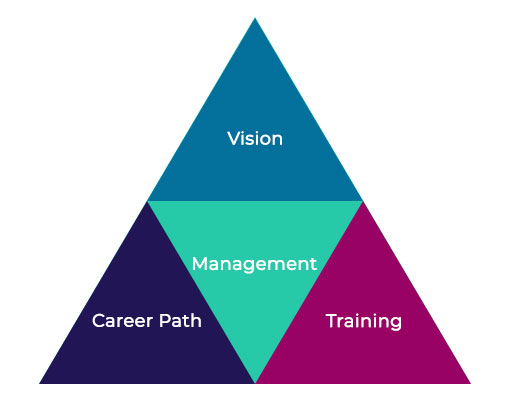
No amount of vision, career path or training will work unless people are inspired by their managers. There is a huge amount of research into inspirational leadership and every book has another idea.
However, analysis of the research tells us that there are fundamental characteristics shared by inspirational managers:
To inspire, managers need to be very good at the technical side of their job. In call centres they need to be very good on the phone, at dealing with customer issues, effective in managing administration and managing resource.
Being technically good means that their ideas and decisions are respected. This does not mean the manager has to be super-human, but they do have to be very good.
Inspirational managers are generally positive and determined. They always state positive belief in team members and push people to do better every day. Another part of their attitude is absolute fairness.
Inspirational managers treat everyone as important, give respect at every level and seek to understand the perspective of their team.
They do not stand on status. One call centre management team the author consulted for gained instant credibility with their employees by agreeing to manage the phones with a skeleton staff while the rest of the centre went on a 2-hour ‘conference’ on a new strategy.
When they arrived to join the conference at the end of the day they received a standing ovation.
Inspiring managers communicate and ensure that the communication has been understood. They never leave their team in the dark and yet have the common sense to toe the management line and keep management confidences.
People are inspired by being listened to and respected. Inspirational managers are confident enough to recognise that people in their team may have better ideas than they do when facing an issue.
To take somebody’s idea, make it work and give them the recognition, is highly motivating. One inspiring manager stated to the author ‘I rise on the shoulders of my team’.
To go right back to the beginning, inspiring managers have direction and a plan. They are able to tell their team where they are going and how to get there.
They then lead from the front, making decisions, clearing barriers from the path and are the first to face challenges.
They never avoid issues or blame others. They encourage and promote their team. When the goal is reached they make it a team achievement and share the glory.
Written by: Gwenllian Williams, Director of deWinton-Williams Business Consulting
For more advice to help inspire contact centre agents, read these articles next:
Reviewed by: Robyn Coppell

The Latest Customer Contact Research, Reports and White Papers straight to your inbox!
Get the latest insights from Call Centre Helper by signing up for our email content.
Close