The Largest Online Community for Contact Centre Professionals


The Largest Online Community for Contact Centre Professionals
 Close
Close



Published On: 6th Aug 2026 10:02
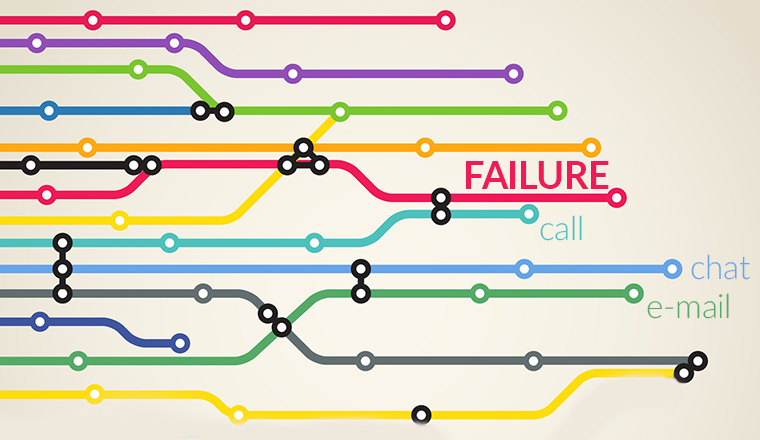
The best way to reduce cost in a call centre is to reduce your Average Handling Time (AHT), right? Wrong!
Forget about your own call centre for a moment and think about your recent interactions with your bank, telecoms or utilities provider. Were you able to get what you wanted without having to chase, follow up or correct an error? If you are able to answer this with a yes, then count yourself lucky. Unfortunately for us as customers, call centre and customer experience professionals, the opposite is an all too familiar occurrence. What we are referring to here is of course Failure Demand.
Failure demand is a concept articulated most prominently by John Seddon of Vanguard Consult and defined as “demand caused by a failure to do something or do something right for the customer” (Seddon 2003). Failure demand in a call centre is typically around 40-60%.
If we have our agents taking calls all day long, and 40-60% of those calls are a result of our failure, then that is a whole lot of calls, cost and unhappy customers that are completely within our control.
Taking this back to my original statement relating to AHT. You might, with really hard work, reduce your AHT by 5%, maybe even 10% over a period of time. However, in most call centres you can reduce your overall demand by 30%+ by reducing your failure demand. Not forgetting the added benefit of improving your customer experience.
Understanding demand
To understand how much demand you have in your call centre is relatively straightforward. The great news is you do not need any expensive customer surveys or any focus groups. Actually, you don’t even need to bother the customer at all. Why? Because the information is right in front of you when the customer calls every day.
To provide a simple every-day scenario with two types of calls:
Clearly the second bullet is the failure demand.
If you spend a little time listening to your calls and categorise those calls that are failure demand you can quickly understand the potential extra cost being added into your call centre and, more importantly, where you are letting the customer down.
A few pointers from my own experience to get good results in understanding your failure demand:
Reducing failure demand
Now you understand your failure demand, how much of it you have, and what is causing it, then it is clear the next stage is reducing it.
How you do this clearly depends on what your failure demand relates to. In my experience, the two most common types of failure demand relate to:
This is normally driven by how we limit our agents in helping customers and answering their demand. This is a sentence that I think is worth repeating: we limit our agents in helping customers.

Costa Stathis
In reality we do this with the right intentions, to give tasks to specialised teams, reduce AHT, etc. However, with failure demand at such high levels, this is clearly a false economy.
Turn your focus to how you can increase the demands that can be serviced at first touch by agents, focus on reducing hand-offs between departments and move as much as you can from back office into the front office and your failure demand will reduce significantly.
With thanks to Costa Stathis www.linkedin.com/in/costastathis.

The Latest Customer Contact Research, Reports and White Papers straight to your inbox!
Get the latest insights from Call Centre Helper by signing up for our email content.
Close