The Largest Online Community for Contact Centre Professionals


The Largest Online Community for Contact Centre Professionals
 Close
Close




Published On: 6th Aug 2026 08:00
A wrap-up code is a predefined label used in contact centres to categorise the outcome of a call or interaction. They will include details such as why the contact was made, what the outcome was, and whether any further action is required.
They streamline reporting, improve call handling efficiency, and provide valuable insights into customer interactions and contact centre performance.
Wrap-up codes are typically selected from a drop-down list of predefined options, providing concise details about the call, such as:
These codes streamline the reporting process and provide a consistent way to summarise call data, providing valuable insights into customer interactions and contact centre performance. For instance, a standard set of wrap-up codes might include:
In most automatic call distribution (ACD) systems, agents are placed in a “not-ready” state after a call, preventing new calls from being routed to them. This period, known as after-call work (ACW), allows agents to complete tasks such as inputting wrap-up codes.
During wrap time, agents may also attach detailed notes to a customer’s file if additional information needs to be recorded. However, wrap-up codes are intended to capture broad, general details rather than detailed call specifics.
Some calls are harder to categorise due to a lack of a suitable code. Regular audits can help identify uncategorised call types and ensure wrap-up codes remain relevant.
Over time, unused or outdated codes should be removed as processes evolve. This ensures agents only deal with a concise and meaningful list of codes, speeding up call handling and reducing errors.
In some contact centres, the accuracy of wrap-up codes is used as a Key Performance Indicator (KPI) for agents. Evaluating call codes during quality assurance checks can reinforce their importance and ensure accuracy.
Do you want to download this to share with your team?
Get your free download of 35 Examples of Call Centre Wrap Up Codes now:
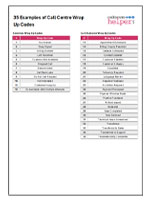
| Free 35 Examples of Call Centre Wrap Up Codes in Printable Excel Format | ||
|---|---|---|
| Version: | 2 | |
| Date Added: | 03 Dec 2024 | |
| File Type: | xlsx | |
| File Size: | 24.7 KB | |
| Download Link: | Download | |
Wrap-up codes provide valuable insights at both the individual customer level and the contact centre level, benefiting service quality, planning, and performance tracking.
Here are a few of the benefits of using wrap up codes:
Because wrap-up codes can be linked to specific customers, they give at-a-glance information about that customer’s history with your business.
For example:
This information allows you to tailor interactions and improve service quality.
Wrap-up codes can trigger additional tools. For example, when a call is tagged as “follow-up required,” agents can schedule a callback and set reminders for future action.
Wrap-up codes also give managers a broad overview of contact centre performance.
For example:
Another major advantage is that wrap-up codes maintain consistency in how agents record call types. This makes it easier for planners to categorise calls and chart the success of different call types at different times.
To get the most out of your wrap-up codes, follow these best practices:
Define codes in terms that align with customer language. Provide examples for agents to reference when selecting a code.
Avoid having too many codes. While additional options provide more insight, they can overwhelm agents and lead to less accurate selections.
Use numeric shortcuts for codes in addition to dropdowns. With practice, most agents can memorise up to 20 codes, saving time during ACW.
Enable agents to apply more than one code if multiple outcomes occur.
Provide an “Other” option for calls that don’t fit predefined categories, allowing agents to add custom comments. This avoids misclassification and preserves data integrity.
Experiment with codes that reflect customer emotions during the call. Knowing how customers feel (e.g., frustrated, satisfied) adds another layer of insight.
We have also produced a comprehensive list of 541 of the contact centre abbreviations, in a contact centre abbreviations that can be used to speed wrap-up time.
Reviewed by: Robyn Coppell

The Latest Customer Contact Research, Reports and White Papers straight to your inbox!
Get the latest insights from Call Centre Helper by signing up for our email content.
Close