
The Largest Online Community for Contact Centre Professionals


The Largest Online Community for Contact Centre Professionals
 Close
Close




Published On: 6th Aug 2026 10:22
The Customer Effort Score has got a lot of airplay – claiming to be the only customer service metric that you would need.
In this article, Guy Fielding looks at these claims and finds that although Customer Effort is a good supporting indicator, it cannot be used as the primary customer service metric.
In summer 2010, when Dixon, Freeman and Toman published their HBR paper “Stop trying to delight your customers”, they not only offered hard-pressed customer service people a tantalising hint of a less demanding service standard, they also made some strong claims for the pre-eminence of Customer Effort as an alternative to both Customer Satisfaction and the Net Promoter Score as the metric by which service operations should be measured and managed. Based on a study of data from 75,000 customers and structured interviews with customer service leaders, they claimed to have shown that:
In their paper Dixon et al. structure the differences between Customer Effort and other measures as a win–lose debate, with the goal of making things easy for the customer simply replacing the need to satisfy (CSat) or delight (NPS) the customer.
Their paper undoubtedly had, and continues to have, a major impact within contact centres. However, we believe that the validity of their argument and resultant claims have not been properly examined.
There are a number of grounds to be cautious before accepting the CE proposition. Some of them are to do with how that argument is made:
Whilst these concerns might make us cautious, the more important test of the Customer Effort Score’s claims is whether their results can be replicated. Since 2010 horizon2 have conducted a number of large-scale studies of UK customer service operations, including:
In these studies we have found a consistent pattern of results which both supports and challenges the Customer Effort Score’s claims.
We measured Overall Customer Effort (on a 9pt scale) and there was a clear and consistent relationship between CE and customers’ evaluations and intentions. For instance:
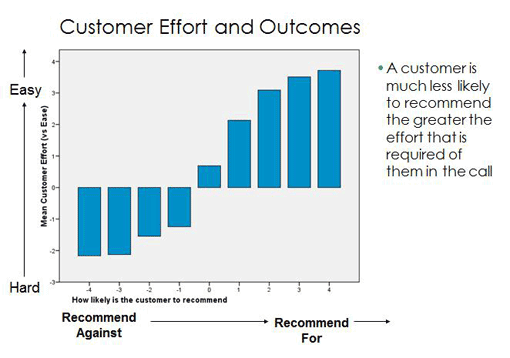
We also identified a large number of events and activities that might possibly contribute to Overall Customer Effort. For instance:
In each case we tested whether there was a significant relationship between this item and Overall Customer Effort, and also whether this problem occurred rarely or frequently. This is important because to make use of the Customer Effort concept you have to know:
To improve things you need to know:
And then of course you have to change things.
Our analyses demonstrate that lots of things in the service interaction influence perceived Customer Effort, and that CE provides a powerful simplifying principle, a design imperative, and a management (and agent) objective (“let’s make things as easy as possible”).
Our analyses also showed that the claim of pre-eminence made for Customer Effort cannot be sustained. Across a series of studies we showed that the best predictor of customer evaluations and intentions was never a single measure of Customer Effort, but instead was a combination of metrics, one of which was CE, but which always included other factors.
Using a statistical technique called linear (multiple) regression, we have shown that customers consider the following factors:
Predictive models taking these factors into account have r-squared values (which indicate the relative predictive power of the model) of 0.8 to 0.9, which account for some 80%+ of the variance in the target outcome variable. In every case we found that, although Customer Effort added significantly to a model’s predictive ability, it was never the most powerful predictor in the model. And in every case we found that other variables, in particular the Judgemental Heuristics-related metrics also increased the predictive power of the model.
We defined Task Resolution from the customer/caller’s point of view: “At the end of the call, to what extent had the customer achieved what they had hoped to and/or expected to achieve when they initiated the call?” Note that this is NOT the same as defining/measuring Task Resolution from the organisation’s point of view. Across a range of purposes and tasks, organisationally defined and customer-defined Task Resolution are often quite different.
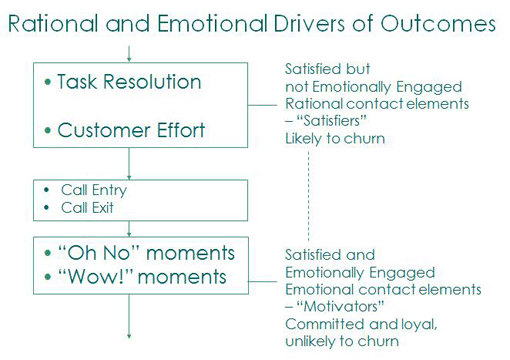
The combination of Task Resolution and Customer Effort drive the customer’s rational (and “common-sense”) evaluation of the call.
If the call solves their problem then, other things being equal, it’s a good call. If the call doesn’t, then it’s a poor call. If achieving that task resolution was easy, then the customer is likely to think it’s an even better call, whereas if achieving that task resolution was hard work then they are likely to think it wasn’t quite as good.
Similarly, if the task was not resolved but realising that that was going to be the case was relatively painless then it won’t be considered a very bad experience, but if the customer has to work hard and still doesn’t get their task completed then they are going to think very poorly of that interaction.
However, these analyses show that when we evaluate our experiences and determine our future behaviours we are not entirely rational. We have identified a series of elements within service interactions which have a disproportionate impact on the customer’s evaluation of that encounter, and on their future behaviour.
We term these elements “Judgemental Heuristics”. They are the “rules of thumb” that people use to short-cut the processing of lots of information.
We have found that the following are consistently powerful within service interactions:
Contact entry: technically known as the Primacy Effect; first impressions count
Contact exit: technically known as the Recency Effect; the most recent impression also counts
“Wow” events: events which surprise and delight, peak experiences, memorable moments
“Oh no” events: events which are negative, when things go wrong, service delivery failures, unpleasant and aversive interactions, etc.
These components of the service interaction, when they occur, are very powerful.
They form the “emotional glue” which can engender customer loyalty, or they can constitute the “emotional landmine” that destroys the organisation’s relationship with the customer. They do not appear to have been included as metrics in the Customer Effort Score’s study, so clearly their importance could not be properly assessed.
However, it is also the case that service organisations are so arranged that their importance can be overlooked. In general, contact entry is a highly structured and invariant part of the interaction. It is also remarkably similar across lots of different organisations. As such, because there is little variation it is difficult for the power of this variable to be detected by statistical analyses which look for the relation of one difference to another. It is also the case, in our experience, that the typical contact entry is, from the customer’s point of view, pretty unattractive and is therefore unlikely to engender positive evaluations and subsequent loyalty. But that doesn’t mean that, in principle, great entries couldn’t be designed, and when they happened, they would have a big positive impact on the customer’s contact experience.
Exactly the same can be said of most contact exits. They are usually formulaic and pretty uninspiring: most contacts end “not with a bang but with a whimper”.
The rather sad fact is that “Wow” moments occur very rarely in service encounters, in part at least because they depend on agents responding to the particularities of the customer and the situation, and organisations go to enormous efforts to “manage out” such variation.
Similarly, organisations try to avoid “Oh no” moments, but unfortunately they are much less successful at doing this, and indeed their efforts to impose consistency on the encounter often cause rather than avoid “Oh no” moments.

Guy Fielding
In a series of empirical studies of UK service operations we have shown that:
Guy Fielding is Director of Research at horizon2

The Latest Customer Contact Research, Reports and White Papers straight to your inbox!
Get the latest insights from Call Centre Helper by signing up for our email content.
Close