The Largest Online Community for Contact Centre Professionals


The Largest Online Community for Contact Centre Professionals
 Close
Close




Published On: 6th Aug 2026 14:00
Chris Angus at 8×8 explains why you can’t blame chatbots for poor customer service.
The latest Institute of Customer Service research shows that customer satisfaction is down across nearly every main industry in the UK, with chatbots shouldering some of the blame—and that’s unfair.
The Institute of Customer Service’s UK Customer Satisfaction Index analysed customer satisfaction metrics across 281 companies in the UK. It’s disappointing to hear that consumer satisfaction has plunged to an eight-year low.
However, it’s important to not pin this on the introduction of chatbots and new technologies and instead see that contact centres are on a journey.
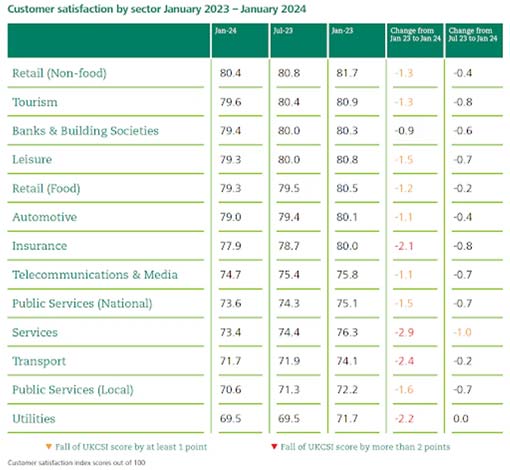
Source: Institute of Customer Service
UK Customer Satisfaction Index
Jo Causon, the Institute’s CEO, says: “These latest figures are a clear signal that organisations need to view service as a strategic imperative.
Customers are demanding better service—sometimes that means tech that works and enables rapid self-service for transactional matters and other times this necessitates talking to a well-trained and empowered human.”
In some ways it’s not a surprise to see a step backwards. The catalyst here is the sub-optimal utilisation of contact centre technology, not just the emerging tech like artificial intelligence and bots.
Anything that has high degrees of complexity can have a negative impact if it isn’t implemented correctly.
The key to AI success, like with any sort of major software adoption, is ensuring that contact centres start at the right level.
Rather than leap ahead, they should take a step back and implement appropriate and relevant customer service use cases.
This will give the AI technology a platform to learn from, and from there, businesses can start developing it.
AI plays a fundamental role in improving customer satisfaction—but it needs to be done right. Our research recently found that 41% of IT leaders believe companies will fall behind if they don’t adopt conversational AI capabilities.
AI chatbots allow contact centres to serve more customers with the headcount they have in place. They also make typically repetitive job roles more interesting.
AI can fulfill mundane duties and allow employees to take on the more challenging tasks and roles, which will in turn help to attract and retain talent, while servicing more customers more consistently.
As with any implementation of technology, the first thing anyone should know is what their end goal looks like. It’s not enough to say ‘we want a chatbot’; you need to know exactly:
Good chatbot implementation starts with a lot of questions.
Once you have an idea of what you want the chatbot to do and how it’s going to engage, it’s then all about training it.
For the best models these days, it’s probably going to involve conversational AI and a Large Language Model (LLM).
With these, you have to start small and build up. Start with your five most common questions and train it from there. Don’t try to do everything at once.
People also need to remember that a chatbot isn’t there to replace humans. It’s there to make for better customer experiences and improved employee experience.
It can provide fast answers to routine questions, allowing human agents to deal with the more challenging issues.
This is a win for everyone because the chatbot quickly deals with the general questions (and the customer gets quick answers) while the human agents deal with more complex matters—and hopefully resolve them to the caller’s satisfaction.
That can be painful for some people to hear, as many IT directors and CFOs think chatbots will let them reduce costs in the contact centre.
The truth is that the last thing the customer wants is to have no human being to talk to when they experience self-service friction.
Around 89% of consumers say they appreciate customer service chatbots for quick answers, but 55% say that being able to get to a human agent, particularly one that’s aware of what they’d communicated to the chatbot, is one of the most important aspects for them in a customer support experience.
At 8×8 last year, we spoke with a global vice president of support whose organisation saved more than one million dollars a year while improving customer satisfaction by 20%.
He said: “You can’t go at AI and automation projects with making cutting costs and cutting jobs your number one goal. If you do, you’re going to cut customer satisfaction, too.
But if you approach AI and automation with a holistic view and look at what the customer needs and how it can complement people and processes, you can very likely have it all.”
In summary, it comes down to:
This post has been re-published by kind permission of 8x8 - view the original article.

8x8 is transforming the future of business communications as a leading Software-as-a-Service provider of voice, video, chat, contact centre, and enterprise-class API solutions, powered by one global cloud communications platform.
Find out more about 8x8

The Latest Customer Contact Research, Reports and White Papers straight to your inbox!
Get the latest insights from Call Centre Helper by signing up for our email content.
Close