
The Largest Online Community for Contact Centre Professionals


The Largest Online Community for Contact Centre Professionals
 Close
Close




Published On: 6th Aug 2026 08:00
We present 50 best practices that may help you to run an even better call centre.
The correct use of idle time has been a subject of much debate for many years in the contact centre.

While some managers require agents to update their skills with online training courses during quiet spells, others allow agents to read, eat or even do nothing between calls.
One idea that can benefit customers and agents alike is multiskilling agents so that they can reply to customer emails between phone calls.
This will help to increase your response rate to customer emails, as well as increase agent productivity and engagement during a slow afternoon.
If you employ homeworkers you need to have a doorbell policy.

This explains what happens if the doorbell rings, for example, for a parcel delivery. If you don’t have a policy you may find that customer calls get interrupted.
Many homeworkers find it useful to have a lockable box, so that if a parcel is to be delivered it can be put into the lockable box, which can then be unlocked during the next break.
Educate yourself about what other contact centres are doing.

Learn from other people’s experiences. Visit virtual events and network with other other attendees. It’s quite easy to track down other contact centre people – either through LinkedIn or through one of the local contract centre organizations.
The Forum also holds a range of regular online site visits.
Online site visits can also help you to build up a range of contacts who may be able to help you out if you need some ideas in the future.
You can probably reciprocate another visit back in return. It’s amazing what ideas you may be able to pick up from a visit.
Take a look at some of the best practices that we’ve picked up on site visits over the years by reading any of the articles under our tag: Site Visit
A simple but highly effective way to increase productivity and to improve accuracy on digital is to teach your advisors touch-typing.

It is relatively easy to teach and can be taught either through an online typing tutor or through the use of a trainer.
The average person types between 35 and 42 words per minute with 92% accuracy using two or more fingers. However, people who learn to touch-type can type a lot faster – up to 65 or 75 words a minute – and often with more accuracy.
You can either find a trainer, book onto a local course (Pitman Training offer local courses) or sign up for an online class.
Calculate, from your calling statistics, when is the best time to call certain customers.

You could also segment your customer base and call each segment on estimations of what time would work best for them.
For instance, you could contact retired people during the day, based on the assumption that they are more likely to be home, whereas working people will be more likely to be home in the evening.
Many contact centres tend to call people from a pre-loaded list, without first looking at their key demographics. This signifies a big lost opportunity for customer engagement.
For more on this topic, read our article: When Is the Best Time to Make an Outbound Call?
A common problem in contact centres is dealing with offensive, rude or harassing callers.

While your company policy may insist that you treat all customers equally, you do occasionally get nasty callers that you don’t want to deal with.
One contact centre that I visited had a problem with a particular caller who would phone the free phone number on the sales line and ask the agent about their underwear.
The contact centre solved this by putting the caller’s phone number into a special routing table that played a busy tone whenever he called in. They were then able to track the 23 occasions where he called in over the next 3 weeks, before he gave up and never called them again.
This solved the call centre a lot of anguish.
For more on dealing with offensive customers, read our article: A Policy for Dealing With Angry and Abusive Customers
Still got paper moving around the contact centre? Automate it!

I’m amazed at how much paper still flows around the contact centre. Post-it notes, customer refunds, leave requests, sandwich orders, visitor badges, car park tickets, team prizes… It’s surprising how much we can generate.
Most of these could be easily automated, either through a web form on your intranet site or a simple email.
So isn’t it time that you decided to ditch the paper?
Set up a team to promote best practice around your organization.

Here’s a simple idea. Set up an Operational Excellence Group in your contact centre.
The initial idea is to find out “what good looks like” and to share it with the rest of the organization.
And it doesn’t all have to be internal. Can you share these ideas with other organizations in your sector and elsewhere?
Once you have a clear definition of excellence in place, it will be a lot easier for your agents to achieve it.
It took many contact centres years to move to homeworking, pre-2020. However, with the COVID-19 pandemic, some contact centres managed to transition to remote working in days.
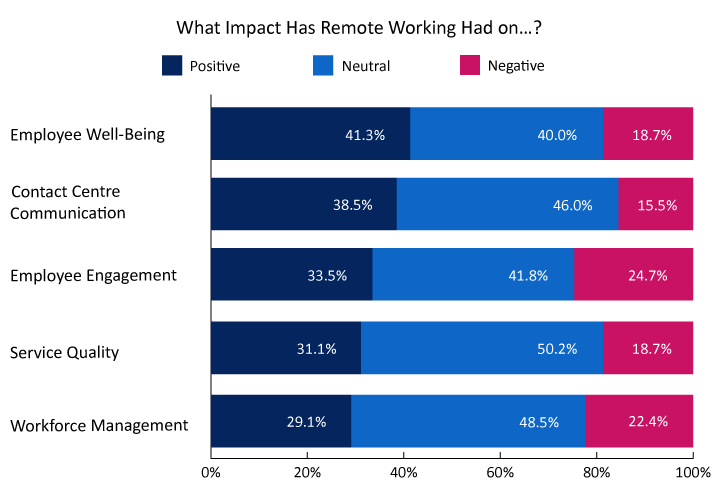
From the chart above, we can see that many contact centres had success in moving to remote working, in a number of key areas, including; employee well-being and engagement, contact centre communication and service quality.
However, there are also many challenges that come with homeworking. For some, this includes security concerns, social isolation and connectivity issues.
With all of these positives and negatives, planning towards a future in a hybrid contact centre – which gives agents more choice over their working environment – is essential .
A funny way to spice up your performance reviews is to have your team leaders dress in scrubs while they listen in on calls.

They can then write out “prescriptions” for the agents, outlining what needs to be improved.
For added effect, you could give out Smarties or Skittles as “medication”. For example, blue Smarties for rapport and red Skittles for script adherence.
For more on getting more from your performance reviews, read our article: 25 Performance Review Phrases for Customer Service
Every contact centre has its myths and legends which tend to be accepted without question.

If you are not careful, these myths can become targets.
This may explain why Average Handling Time is used in so many contact centres.
It may surprise the sales director, but some of the best sellers in your company are customer service agents.

These are the people who day-in and day-out are giving customers advice on how to use your products, solving customer problems and stopping them from leaving.
So maybe it might be nice if these agents were in some way recognized for their sales efforts. I’m not suggesting an individual commission scheme, but some group-based sales performance bonus may help to recognize their efforts.
It’s a good time to tweak your IVR and on-hold messages. You will probably find that small changes could make a big difference.

For example, instead of saying: “For sales press 1,” try: “For sales press 1 NOW.”
You should also make sure that your messages are in spoken rather than written language.
You should also use short words – like “buy” instead of “purchase”.
For more on how to improve the IVR, read our article: Call Centre IVRs – How to Review and Improve Your IVR
One of the problems with training is that it is a bit like going through the annual “sheep dip”, as everyone completes their training and then goes back to their usual bad habits.

Here are a few ideas to help you avoid the “sheep dip”:
Unless it really goes against your brand’s image, be careful what you put out on social media.

Live life online like your mother is watching;
Staff perform better if they can have a bit of downtime during their breaks.

To help your agents properly recharge, you could try installing some games for them to play (e.g. table tennis, arcade machines, table football, a pool table or an Xbox), putting plants around the office, or encouraging people to bring in their old magazines and second-hand books to create a reading corner.
Applying a combination of the above to your contact centre should help to make your staff more alert when they go back on the phones.
In the remote contact centre, talk to agents about how they use their downtime and maybe create virtual spaces where the team can enjoy their breaks together by helping them run virtual quizzes, book clubs or just coffee breaks.
A simple way to improve communication within the contact centre is to set up an internal Facebook group. This can be hidden from the outside world and could be a great way for staff to share ideas.

This should help you to monitor the levels of morale in the contact centre, although you will need to set expectations and produce some usage guidelines right from the start.
For more on how to best use online contact centre community groups, read our article: A Simple Way to Improve Communication in the Contact Centre
A great way to improve training in your contact centre is to turn it into a development programme.

You could start by identifying 10 different levels of training that people have to achieve.
To incentivize the training, you could then put in a different pay scale for each of the grades, or give out a bonus when a certain level has been achieved.
You could also make it rather like an end-of-school exam, and have “graduation ceremonies” when people pass a certain level.
For more advice on how to get even more from your contact centre training, read our article: 50 Call Centre Training Tips
This is a scheme where you encourage colleagues to recognize each other for those “moments of wow”. It could be for helping each other or for helping the customer.

Any member of staff could nominate another. This can be done on a card or through a form on the intranet.
At the end of the month, you could pick a number of winners to select something from the “goodie” cupboard. You could then have a £50 prize for the best nomination of the month and a £250 prize for the best of the year.
Contact centres are often quite good at providing updates, but what happens if the advisor is on holiday or off sick when the update is provided?

If you keep a log of what is happening in the contact centre it will be much easier for the advisor to find out what has changed while they were away.
Assign an experienced member of staff (a “buddy”) to help new staff members settle in to the company.

Make sure that you choose wisely or you may find that bad practice spreads through the new recruits.
Ring-fence training sessions so that no matter how busy things get, you can still provide ongoing training.

You will need to get another team to provide cover or back-fill the trainees.
It’s a slippery slope if you cancel training because you are too busy.
Allow agents and advisors to put forward calls that they feel they have done well on.

This helps to build up their confidence, rewards good behaviour and could also be used to help to train new recruits.
If you are recruiting for a new person into the contact centre, first ask your advisors if anyone would like to change their shift. Then you can go about back-filling their existing shift.

This is a great way to give some more flexibility, and could help to solve some attrition problems. On average, you could find out that around 20–30% of positions are filled internally in this way.
Here is a clever thing to do. Get some call abandon data from your system and plot a call abandon curve. This starts with 100% of callers at 0 seconds of queueing and goes down over time.

You may find that you get large numbers of callers after certain messages are played.
One contact centre that I spoke with was able to reduce its abandoned percentage from 7% down to 2.9% simply by changing one of the IVR messages. (It tends to be the second one that is the culprit.)
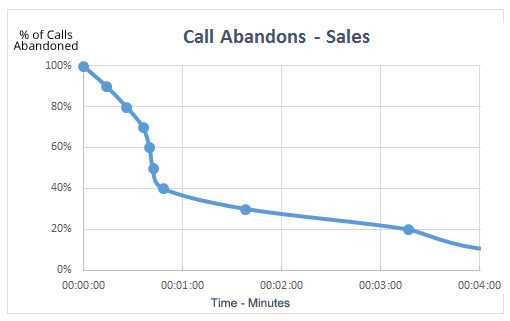
Find out how to create an abandon curve like this by reading our article: How to Bring Down Your Call-Abandon Rates
Annualized hours is a great way to provide flexibility and avoid overtime.

In essence, you are looking for a number of hours that need to be worked across the business year. During busy periods, such as in the run-up to Christmas, you can offer staff extra hours. Instead of overtime, the extra hours can be built up for later in the year.
During quieter periods, such as during the summer, staff can then use these hours and take off extra days.
This type of flexibility can often be a win–win situation. It can help to reduce overtime and also allow staff to take extra time off.
For more on implementing annualized hours in the contact centre: Six Steps to Implement Annualized Hours in the Contact Centre
One of the most common problems that I hear is that advisors do not read the emails that are sent to them – particularly in relation to new products and new updates.

Here are a few other ways to get the message out:
When you are designing the IVR options, put the largest-volume options at the start of the IVR.

So if the customer service department gets the bulk of the phone calls, make this the first option on the IVR.
A simple technique, but it means that the bulk of your callers can move through the system speedily and easily.
Buddy-up your new agents with those that have only recently joined your contact centre – instead partnering new agents with experienced ones.

By doing this, you will avoid teaching new agents the bad habits and short cuts that the old agents may have picked up.
If you move back to the contact centre, in the post-COVID world, consider this best practice when it comes to your seating arrangements.
If you are looking to share knowledge within the company, then why not implement an internal social media type site?

There are lots of different solutions out there from intranet sites to systems that have a Twitter or Facebook look and feel.
This will particularly help you to engage your younger employees.
If you are not careful, over time, the contact centre can look a bit of a mess. Old posters on the walls, piles of old paperwork on the desks, and piles of old food in the fridges.

Remember this if you plan to move back to the contact centre, and do regular “clean room” sessions. Clear out old stuff, give it all a spring clean and get rid of the clutter. If you can, bring in the decorators over the weekend to paint the walls and fit new carpet.
It will make the call centre feel much fresher and may help to reinvigorate the whole centre and reduce stress. And that can’t be a bad thing.
A powerful technique to improve performance is to introduce agent self-evaluation.

People are more critical of themselves and can take more ownership of the calls and how they are handled.
This is very powerful as it gives agents the opportunity to change their own behaviour.
For more tips to get agents more interested in quality assurance (QA), read our article: How to Get Advisors to Buy In to Your Quality Assurance Programme
If somebody has phoned in sick, phone them back later in the day to find out how they are getting on. It shows that you care as a manager, and it is a great technique for reducing absence rates.

It also works well for people who take off a Monday because of a hangover and then feel they have to take off Tuesday as well to make it look genuine.
Too many contact centres have poor links with Marketing. The first time that you know a mailing has gone out is when the call volumes have increased.

Start building better links with the marketing department. Things such as a staff swap for a couple of days can be highly effective.
The use of wallboards and dashboards in the contact centre is one of the most controversial topics in the industry – with some managers using them to share the latest Average Handling Time (AHT) targets, while others use them only to celebrate their agents’ achievements.

Whatever your standpoint, the end-goal should be the same… Your wallboards and dashboards should help to create a happier, better-informed workforce – not terrify your agents into early retirement!
Not sure what impact your wallboards are having? Ask your agents!
Once a month, take your best agents out for an all-expenses-paid meal. This could be based on anything from quality scores to attendance.

Alternatively, you could play motivational games like snakes and ladders – where the first 10 agents to reach the top of the board get to go!
In times when a meal isn’t possible, get your top performers some food vouchers (i.e. Deliveroo or Uber Eats) and have a virtual meal with your team.
Have a scheme that allows agents to work from home on Friday, if you are operating in a hybrid contact centre model.

It’s quite feasible with the latest technology and could help to keep your agents refreshed.
If you are looking to invigorate the management team, take them out of their regular environment by having an away day.

This does not have to cost a lot of money, as you could hire a local hotel for less than £50 per head, or bring in an external facilitator for less than £400.
There are also plenty of things that you could arrange yourself, such as brainstorming and team-building activities, or even a treasure hunt around the local park.
If you are moving your contact centre technology into the cloud, what will you do if the cloud-based vendor goes out of business?

You could rapidly end up with no technology provision. Do you have a fall-back plan in place?
People need time to debrief after a customer has been nasty to them – particularly when the customer was abusive or aggressive.

Let them chat to other advisors, or allow them to go for their break early.
To better prepare your team for nasty customers, read our article: Dealing With Angry Customers
Don’t penalize people for spending too long on the phone. They are helping customers.

If you make a big deal about the Average Handling Time (AHT) figures in your contact centre, you will probably find that your First Call Resolution (FCR) figures will get worse.
Failure demand is widespread in most contact centres. The average is around 40%.

High failure demand is typically where people call you because of a failure in a service that you provide, because you have not solved the problem on an earlier call, or where you have not provided the right information on your website.
An easy way to measure this is to listen to 100 calls and to score them with a measure of failure demand.
For more on this topic, read our article: Failure Demand – Reducing Cost and Improving the Customer Experience
These are lean process meetings held for a maximum of 5 minutes standing up – in a virtual platform – at the start of the day.

These briefing sessions can be used to distribute news and also set the plan of action for the day. They should be run by the team, so that all members get a chance to run them. Be careful that they do not turn into “morning prayers”.
Here are three tell-tale signs of broken desktops.
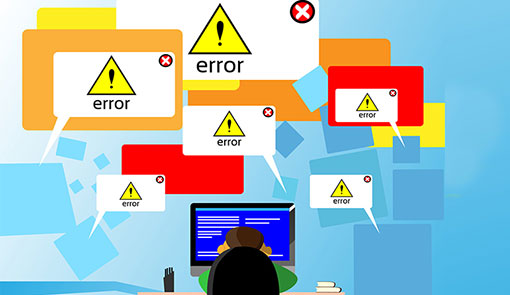
Encourage everyone so that if they see something that is broken (for example a broken process) they take ownership to make sure that it is fixed.

However, you need to make sure that your culture is right for this to work, otherwise agents will avoid shouting out things that are wrong, because they see it as more work in the short term.
To find out how to build a positive culture, read our article: Create and Maintain a Positive Culture
Rather that direct selling (the hard sell), instead try to build some rapport and empathy to encourage the prospective customer to make a buying decision.

One of our top tips for selling over the phone is to use the selling model “IDEA”.
I – Interest
D – Desire
E – Evaluate
A – Action
It is a simple sales-funnel-type model where you try to move the prospective customer along the sales process.
These are virtual discussion groups where agents can voice their own concerns about quality and how it can be improved.

These can work well when the agents are also empowered to go on and make any changes that they suggest.
For more tips on how you can improve your quality assurance (QA) programme, read our article: Call Centre Quality Assurance: How to Create an Excellent QA Programme
Speech analytics seems to becoming more widespread. There seem to be more people doing it (and more people looking to implement it).

It is proving to be more effective than just sampling the odd phone call, where you can easily miss a lot of key information.
Carry out customer role plays. Having the chance to role-play and try out handling specific scenarios is best practice to give new agents an experience of what it is like to work in the contact centre.

These can be useful for induction training but may also be helpful when bringing in a new process.
Find examples of great customer role plays in our article: 9 Customer Service Role Plays
Autoglass found out that 18% of customers were abandoning in the IVR. They had not seen this in their ACD stats, which only started the queue once the caller had left the IVR. They found it very difficult to get a figure for the number of abandons in the IVR.

They did a full IVR review and cut down the time in the IVR down to just 8 seconds. This helped to bring down their overall abandon rate.
One observation that I have found from other contact centres is that abandon rates in the IVR of 10–20% are not untypical.
To find out more about properly calculating call abandons, read our article: How to Measure Call Abandon Rate
For lots more quick-fire best practices for running a great contact centre, read our articles:

The Latest Customer Contact Research, Reports and White Papers straight to your inbox!
Get the latest insights from Call Centre Helper by signing up for our email content.
Close