The Largest Online Community for Contact Centre Professionals


The Largest Online Community for Contact Centre Professionals
 Close
Close




Published On: 6th Aug 2026 08:00
We provide a simple step-by-step approach to forecasting demand in the contact centre.
To predict the future, we first need to understand what has happened in the past.
When we look into past contact volumes, there are three key things that we need to identify that will give us an idea of future demand. These are our three key “building blocks”:
These building blocks are the basis of almost every forecasting model. However, there are also “noise factors”, which we need to account for.
Noise factors are special events or causes that will potentially damage the accuracy of your forecasts. Examples of noise factors include:
Now you understand trend, seasonality, level and noise factors, all that you need to do before you start building your forecast is:
The source and the accessibility of the data that you will use for your forecast will depend on a number of different factors. These include:
We must identify what data we need, considering our building blocks above, and what data we have available.
Knowing this, we must identify what data we need, considering our building blocks above, and what data we have available.
If no data is available, you can use financial reports and professional feedback from planning experts in your sector. More insights on this can be found in our article: How to Forecast With Minimal Data
Yet if we are lucky to have daily contact volumes from the past three years or more, we can move on to the next stages of:
Once you have gathered your historical contact volumes, cleaned the data and identified your noise factors, it is time to choose which forecasting model you will use.
There are many models of forecasting demand out there. Some of the most common in the call centre include:
Triple Exponential Smoothing (Holt Winters) – This model uses trend, level and seasonality on a month-by-month basis. The level is last month’s contact volumes. The trend is the expected change in volumes from last month. The seasonality is the impact of the seasons on the volume. You then use these to forecast the next month’s demand, which you can chop into smaller chunks and identify potential noise factors.
ARIMA – This model can get very technical, but at a basic level it involves comparing recent demand with past patterns and identifying key similarities and differences. Understanding these, you predict a future pattern and apply a “moving average”, which is a value that defines how quickly contact volumes are either increasing or decreasing.
Jonty Peace, Editor of Call Centre Helper, discusses in better detail how both of these forecasting models work in the video below:
Home-Grown Algorithms – If you have worked in a contact centre for long enough, you may be able to forecast based on your own set of rules, parameters and steps. These can all be formulated into an algorithm, which does much of the hard graft for you. You just need to remember to look over the results yourself, using your planning and forecasting wisdom to ensure it is not producing any errors that may skew your results.
Yet many contact centres still use more manual methods of forecasting, which will most likely follow a refined version of the five steps below:
Just remember, though, that you want to experiment with as many different forecasting models as possible in order to find out which works best for your contact centre. Don’t just wait until something goes wrong to start experimenting.
To find out about the latest most sophisticated forecasting methods, read our article: The Latest Techniques for Call Centre Forecasting
You need to test your forecasting model to see if it provides accurate results, before you start using it in the contact centre.
To test the accuracy of your forecasting model, make a forecast for a certain time in the past and measure forecast accuracy. This will give you an idea of how well it will work in your contact centre environment.
If the results are not accurate, the planner will tweak their forecasting model until they consistently achieve a better forecast accuracy with their new model than with the contact centre’s old model.
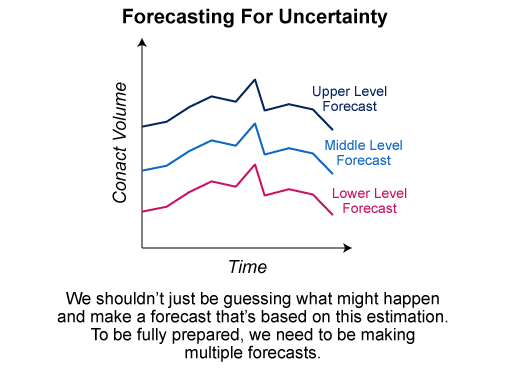
When in this testing phase – as well as when you take your forecasting model into the “real world” – it can also be best practice to create three forecasts (or maybe even more) using the same model.
This is important because all forecasts have a certain amount of uncertainty in them. So if we can create Upper-, Middle- and Lower-level forecasts, we can be prepared for every possible scenario.
Other quick pieces of advice for testing your forecast model include:
While your forecasting model may have already considered these to some extent, there are a number of special events – some of which may be at very short notice – that can impact your forecast.
This is why it is so important, when you gather and collect your data, to question your outliers and assess the cause and effect of your noise factors.
It is so important, when you gather and collect your data, to question your outliers and assess the cause and effect of your noise factors.
What you will find is a number of noise factors that you hadn’t previously considered – like weather conditions, student term schedules or the clocks changing.
But when you put your forecasts together – maybe a month in advance – many of the noise factors will have not yet come to light.
It is therefore important to not only understand all of your noise factors, but to identify any sudden causes for them and know their potential impact, so you can address your forecast accordingly.
To keep tabs on these noise factors it is important to ask for updates on the actions of other departments, monitor changes customer behaviour and watch the news.
Once you’ve starting using your forecasting model to predict demand, it is good to take a step back and ask: what could we do differently in the future?
You’ve got to learn the lessons when things go wrong or when you get a little lucky…
No forecasting model is 100% accurate all of the time, but you’ve got to learn the lessons when things go wrong or when you get a little lucky, otherwise your forecast accuracy won’t improve.
So learn those lessons and then start to build on your model, trying out a few ideas to improve forecast accuracy, once again going back to a safe environment to start with.
Some advice that may help you to improve your forecasting process includes:
For more advice on improving how you forecast demand and other planning guidance, listen to the following episode of The Contact Centre Podcast, which features workforce management (WFM) expert Doug Casterton.
The Contact Centre Podcast – Episode 22:
For more information on this podcast visit Podcast – Resource Planning Advice to Boost Efficiency and Engagement
To close this article, let’s take a quick look at some resources and tools that will help you further in your journey to creating the best possible contact centre forecast.
Of course the most helpful forecasting tool is software from a specialist WFM provider.

The Latest Customer Contact Research, Reports and White Papers straight to your inbox!
Get the latest insights from Call Centre Helper by signing up for our email content.
Close