The Largest Online Community for Contact Centre Professionals


The Largest Online Community for Contact Centre Professionals
 Close
Close




Published On: 6th Aug 2026 08:00
We explore innovative customer engagement strategies that have been derived from the principles of behavioural science.
Alongside each customer engagement strategy, we refer to the behavioural science principle and explain how it works.
Armed with these descriptions, you can come up with some other ideas to engage customers – but the six strategies below have all been proven to have a positive impact on customer engagement within the contact centre environment.
If you are looking for ways to increase customer engagement across the entire organization – not just the contact centre – the following article might just be the one for you: 5 Customer Engagement Strategies That You Cannot Ignore
Authority Bias means that we tend to trust people in positions of authority, such as doctors or celebrities. We therefore place more importance on their opinions and contributions.
Using this logic, you can develop customer trust in what an advisor has to say if the advisor demonstrates their expertise right from their initial greeting. Yet that rarely happens.
More often than not, an advisor will open up the call by using a phrase that’s similar to the common greeting statements below:
Not one of these statements enables the advisor to demonstrate their authority through “cues of expertise” from the off – which signals a missed opportunity.

This is according to Ziba Goddard, Head of Core Consulting at Cowry Consulting, who tells us: “We know psychologically that the start is pretty much the most important point in any conversation.”
“There’s something called the ‘primacy effect’, which dictates that when we first hear someone introduce themselves, we form an impression of them, and we look to confirm that impression throughout the call.”
So you really want to make a good, authoritative impression right away. One contact centre opted for another approach instead…
To apply the principles behind the authority bias and the primacy effect, Ziba suggested to one company that they greet customers with the following phrase:
Two techniques are at play here to increase customer engagement. The first technique is that the advisor is stating their job title, helping to establish their expertise and authority.
As Ziba says: “Job title and years of service are very good cues to expertise.”
Secondly, the advisor is taking charge of the call early by asking a closed question– which again highlights authority, but also plays to something called the “Status Quo Bias”. This leads us on to our second customer engagement strategy.
When using both of these first two strategies together, the contact centre that Ziba worked with not only achieved increased customer satisfaction, but also realized a 17% reduction in Average Handling Time (AHT).
For more of our advice for reducing AHT, read our article: 49 Tips for Reducing Average Handling Time (AHT)
Status Quo Bias refers to the fact that people generally don’t like change and prefer things to remain the same. The more we behave a certain way, the more automatic this behaviour becomes.
From this human behaviour, we can see that customers like defaults. If you think how this applies to customer engagement in the contact centre, you can theorize that customers would like to be led through the call. They want you to own their problem.
So, to engage customers you want to signpost key stages of an interaction with them – once you’ve diagnosed the customer’s problem. This involves breaking down your most common contact reasons into key stages.
Then you can coach advisors to signpost to customers, at the start of every call, the basic steps that you will take with them to solve the problem and everything that they will need to provide you with during the call (e.g. account numbers, personal information etc.).
This process may take a considerable amount of time to coach, but you can just take it one contact reason at a time, and it can pay off…
Find out more about signposting in our article: Signposting – Reduce Your Average Handling Time (AHT) by 15 Seconds
In the case of one contact centre, customers had to be taken through security, but advisors would only take customers through this process once they had understood their query and this disturbed the flow of the call, with customers feeling as though they were going backwards.
So Ziba recommended to them that straight after the initial greeting, in which the advisor would typically ask the customer to relay their query before asking any security questions (as in the first strategy), the advisor should instead say:
This enabled advisors to own this section of the call and set the right tone for the rest of the conversation.
“By going straight into security and not giving customers the chance to relay their query, we can then get them through the front section of the call and answer the customer’s query fluently afterwards,” adds Ziba.
Of course, in this example a passive voice biometric system or an IVR with a certain security functionality can help to remove this security process in the first place. But the same logic of truncating customer contacts can be applied to the remainder of the conversation.
Nudge Theory refers to how seemingly small changes can create seismic shifts in behaviour.
Famous “nudges” in the field of customer engagement and customer experience include:
But how can you apply these small nudges to the contact centre to help improve customer engagement?
One example would be in using your IVR to shift customers from the phone channel to online self-service, which you can do by introducing social-normative nudges. If your online experience is much less effortless, you can then direct customers to a much more engaging experience.
Nudging customers through IVR messaging like this may also help to relieve the burden on the customer service team, allowing them to focus on more technical call types.
For more on improving your on-hold messaging, read our article: How to Write the Best IVR Messages – With Examples
Ambiguity Aversion alludes to the fact that people generally have a preference for risks that are associated with known probabilities rather than uncertainties where probabilities are unknown.
This human bias denotes the importance of managing customer expectations. This principle can be applied across the customer experience, including how you interact with customers.
If you think about classic contact centre conversations, a big source of ambiguity comes from how you manage silence. How many times have you heard the following conversation play out?
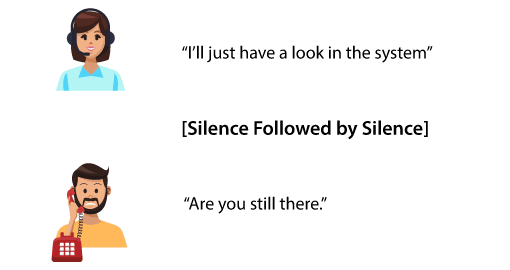
This is a big source of friction and it leads to a significant drop in customer engagement.
Now there are a number of things that you can do to remove this ambiguity, such as:
But there is one method that has been proved to work really well in contact centres to improve the quality of conversations and engagement levels.
To manage silence, it is best to set the period of silence up with a statement like:
It is very unlikely that a customer will respond by saying “no”, while this statement also helps to manage their expectations.
If the advisor knows how long it will take to find the information, from experience – adding a time guarantee can also help to further remove ambiguity.
Removing ambiguity in this way is especially important if you use the hold function, as you can’t give updates about what you are doing in the same helpful way as you might do otherwise.
For more on the topic of removing periods of silence from calls, read our article: Seven Tips to Avoid Dead Air Time in Phone Conversations
Commitment Bias gets its name from the psychological principle that once people have made a commitment to do something, they are much more likely to achieve their end goal.
Getting the customer to commit to doing something at the end of the call can therefore be a powerful method for encouraging further engagement. But you need to be careful in how you do this.
For example, let’s take a look at a classic way in which many contact centres look to complete calls:
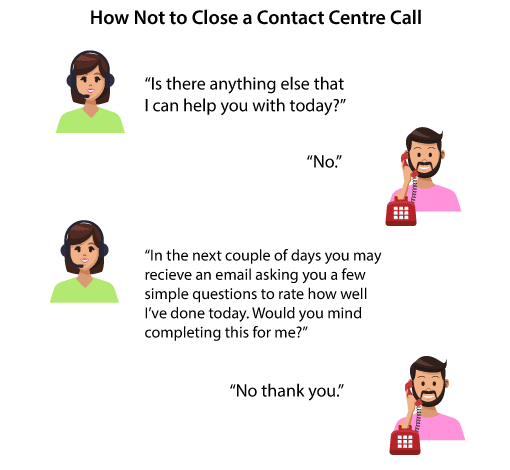
One key problem of ending the call in this way is that we – as human beings – like to be consistent with what we have previously said, so we are more likely to say “no” to any such follow-up question.
However, if we had said the word “yes” before, then we are more likely to say “yes” to the follow-up question and make a commitment to engage again, or, in the example above, participate in the survey.
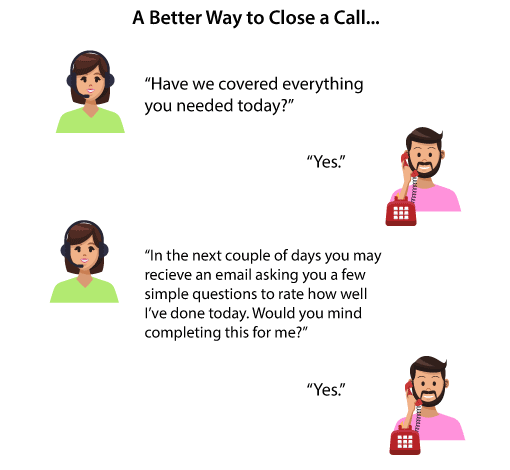
By reframing the initial question to something which the customer is much more likely to say “yes” rather than “no” to, you are ensuring that customer is much more likely to say “yes” to your next question too.
If you can position this question to be something that encourages further engagement, you can get many more customers to commit to re-engage with you.
“When we’ve made a commitment, we don’t like to go against what we’ve said that we are going to do because it makes us seem untrustworthy,” says Ziba.
When Ziba tried this out with one contact centre, not only did they see survey completion rapidly increase but, the contact centre’s Net Promoter Score jumped from +17 to +32 in just five weeks.
Find more clever tactics for improving NPS, by reading our article: 16 Ways to Improve Your Net Promoter Score
Mirror Neurons are brain cells that react both when we perform and when we observe an action – which could be something as simple as a facial cue.
While mirror neurons are not based on biases in human behaviour, you can think of how mirror neurons work when designing the advisor experience.
If you can do this and create a more engaging experience for your advisors, you can also increase customer engagement in the process.
As a reader of ours once told us: “Happy staff = happy customers. Engaged staff = engaged customers. Culture is key to delivering employee engagement and therefore outstanding customer experience.”
If you engage the contact centre team with your customer base and ask them to picture those customers when someone calls in – whether they are happy or unhappy – you can trigger those mirror neurons to increase engagement.
Two other strategies that Cowry Consulting have used to improve employee engagement – and consequently customer engagement – are:
To find other ways to increase customer engagement and improve customer experience, read our articles:
Reviewed by: Hannah Swankie

The Latest Customer Contact Research, Reports and White Papers straight to your inbox!
Get the latest insights from Call Centre Helper by signing up for our email content.
Close