The Largest Online Community for Contact Centre Professionals


The Largest Online Community for Contact Centre Professionals
 Close
Close




Published On: 6th Aug 2026 08:00
Here are some ideas we picked up on a site visit to the UCAS contact centre in Cheltenham.
A great way to help engage your agents with the business as a whole is to involve them in the recruitment process.
Not only will this get them off the phones for a day and give their work some variety, but it will also help with buy-in when it comes to introducing the new recruits to the floor.
| UCAS Fact File | |
|---|---|
| Agents | 35 seats 31 FTE |
| Call volume | Inbound: 8,000 calls per week. (40,000 a day at peak times.) Outbound: Small occasional campaigns, varied volumes. Social Media: 2,000 responses per week, up to 3,500 per day at peak. |
| Technology | |
| ACD | Storm |
| Headsets | Plantronics |
| WFM | Teleopti |
| Agent Desktop | In-house system |
| Call Recording | Storm |
| Call Scoring | In-house form |
Creating a ‘Head of Customer Experience’ position for each customer group is a great way to focus all activity on the customer journey.
Responsibilities include conveying what is happening in the contact centre to other areas of the business, as well as looking at how any forthcoming changes will impact the customer.
The UCAS team have a ‘Head of Customer Experience’ for each of their three customer groups – applicants, universities and college advisors. Their focus is on maintaining a consistently high-standard customer experience across all touchpoints.
Agents are frequently given the opportunity to represent the company at conferences and university open days across the country. This helps to give them a greater sense of purpose in the organisation.
“Our agents love getting involved in off-site activities, as it gives them a chance to build new skills and do something different with their day. It also makes them feel like business representatives, rather than just call centre agents,” said Stuart Williams, Contact Centre Manager at UCAS.
“By sending our agents to these events, we can also be confident that the students and parents are getting up-to-date and accurate information from the experts. After all, our agents are trained to deal with complex questions every day.”

Floor-walking supervisors are a great resource for agents. However, a wave for help can easily be confused with a stretch or yawn.
To avoid this confusion, give each agent a brightly coloured ‘Assist Card’. These cards can be held up in times of genuine difficultly and can help to ensure that your supervisors don’t waste time on false alarms.
You should also keep a log of why your agents needed help, and use this information to address any gaps in training.

Ask your agents to write down what they love about their job and working for the company.
You can then create an art project in your contact centre featuring these positive thoughts – inscribing them in glass or Pyrex, or simply writing them out on paper hearts, depending on your budget.
It is all too easy for important company messages to get lost in the shuffle of day-to-day activity, even if they are emailed to everyone in the building.
To overcome this, UCAS has a monthly “Shut Down” where all agents are taken off the phones for an hour and a half – and outsourcers cover the main lines.
During this time, the whole business comes together in a conference suite.
This is a great way to make sure that everyone gets the same information at the same time, as well as boost morale and interdepartmental communication.

In addition to Facebook and Twitter, UCAS also communicates with their customer base online via their YouTube channel.
Their YouTube videos cover a wide range of topics, from explaining the difference between undergraduate and postgraduate study, to detail exactly what needs to go in a personal statement.
These videos are then embedded on the company website and shared across social media to help educate their audience.
This strategy has been known to drive down inbound contact by making it easier for customers to self-serve – and is especially effective if the contact centre is able to feed ‘video ideas’ to the marketing department based on the FAQs coming in.
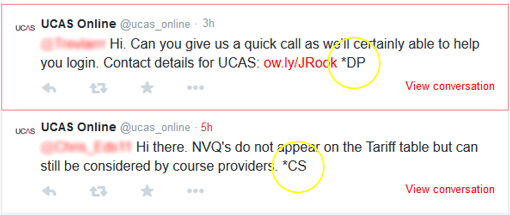
It can be quite challenging to monitor who said what to whom on Twitter, especially when your agents are covering a single account on short shifts throughout the day.
A simple solution to this problem is for your agents to mark every tweet with their initials. This insight can help managers address quality and training issues.
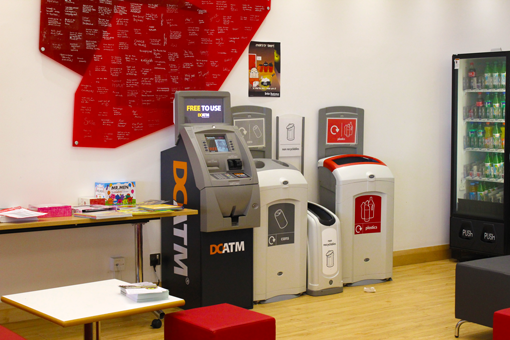
Placing a cash machine (ideally one which doesn’t charge for withdrawals) in your canteen or break-out room can help to make your agents’ lives that bit easier.
This will make a more noticeable impact if your contact centre is on a business park with no ATM nearby.
Two years on, we revisited the UCAS contact centre and found five more ideas.
In the past month, UCAS have moved on from the traditional tick box method of scoring agents in quality monitoring sessions, and have instead created a three-star system.
This system, as highlighted in the following image, was brought in to ensure overall quality and to encourage natural conversation, as opposed to dropping a list of elements into an interaction.
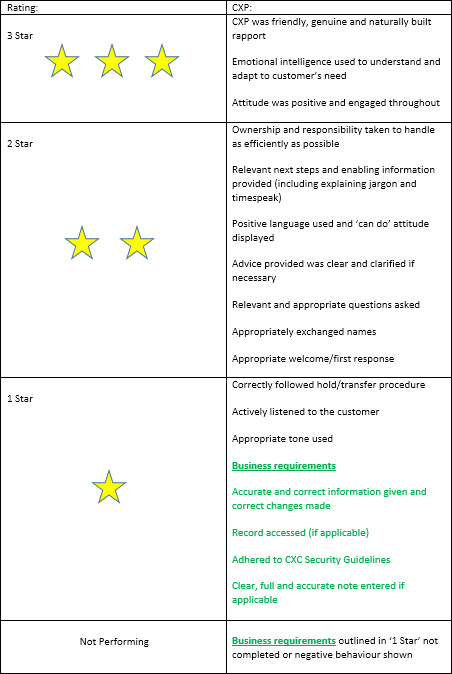
UCAS commented that they were already having “success” with their new system, as it also sparked conversation between call analysts and agents on how they could improve. This is in terms of using positive language, building rapport and being emotionally intelligent, rather than a tick box system that reminds advisors of what they forgot to do.
To ensure that advisors are scored fairly in quality monitoring sessions, UCAS hold calibration sessions and invite a couple of different agents each time.
This has helped to close the gap between the way agents interpret the new-three star scoring system and the way in which analysts do. By boosting this understanding, agents can then replicate the behaviours that they know analysts, and consequently the wider business, values.
UCAS often run advisor focus groups to determine areas in which the agent role could be simplified, job satisfaction could be enhanced and the customer experience improved.
Any ideas for how to do so are then collected and sorted using the grid below.
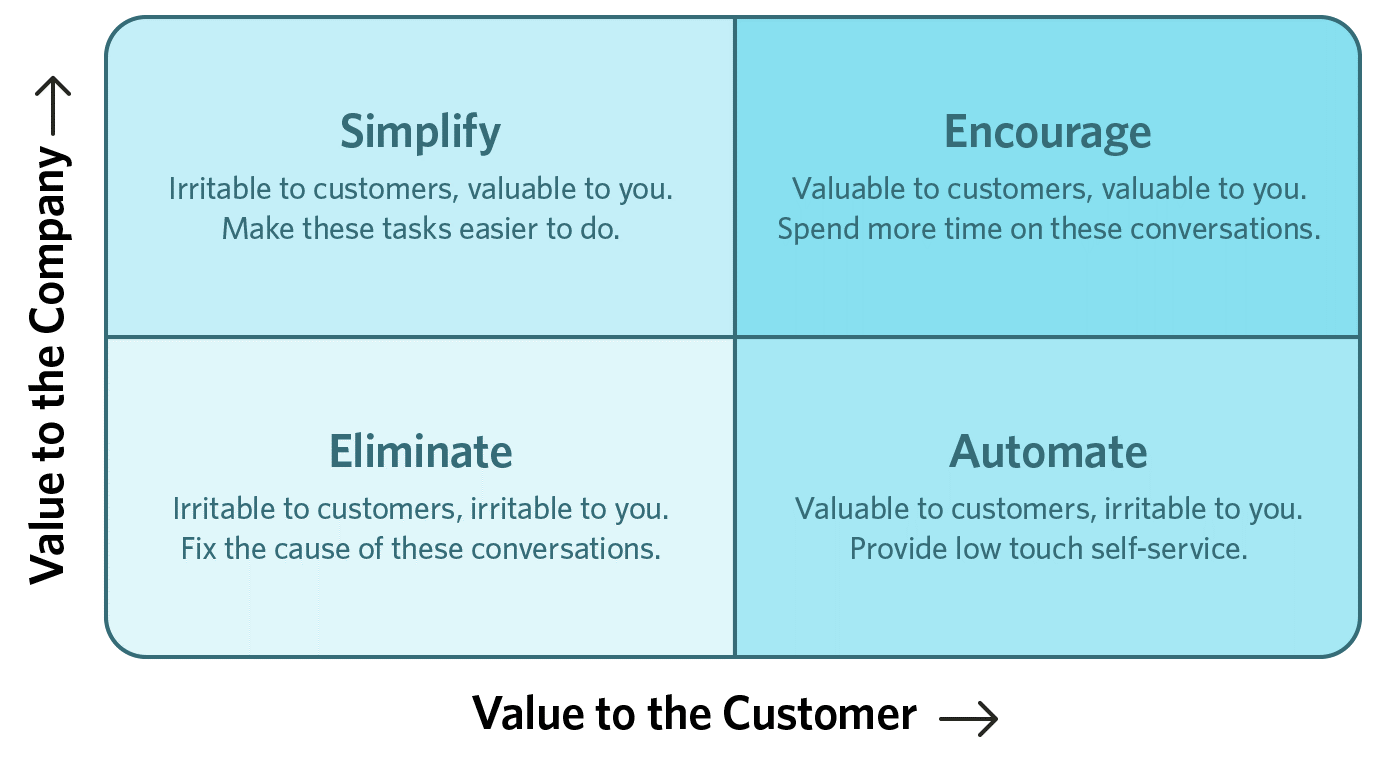
(This grid is further discussed in the article: A Simple Technique to Improve Your Contact Centre Strategy)
Senior managers use this grid so that:
In addition, any processes that advisors report customers are having issues with are set out in a flow chart named the “waste snake”, with the first step beginning at the head of a snake, with the process drawn out across its body.
This then presents an overall picture from which managers can find areas to simplify, automate or eliminate.
[Processes must not be confused with the customer journey. For more information on their distinction, read our article: 6 Ideas for Customer Journey Mapping]
To gain a greater understanding of the customer experience, newbies in the UCAS contact centre are asked to create their own university applications, without hitting the final submission button.
Also, when one small process is changed, each advisor will have to repeat the process, so advisors have first-hand knowledge of the exact journey being undertaken by the person on the other end of the phone.
With UCAS being in the rather unique position of taking 8-10% of their annual call volume in one day, the contact centre needs be specially equipped for peak periods.
So, with help from their outsource partner, the company target certain other professions and offer part-time work. In fact, UCAS mainly target supply teachers, who are likely to have time free in August, as they have a better understanding of guiding students through the process than most.
Are there any professions that your contact centre can target during peak periods? Maybe university students, who have a good understanding of the business and are in need of the money?
It may be better for morale to recruit these part-timers than to force advisors to work during certain times in the year.
Reviewed by: Robyn Coppell

The Latest Customer Contact Research, Reports and White Papers straight to your inbox!
Get the latest insights from Call Centre Helper by signing up for our email content.
Close