
The Largest Online Community for Contact Centre Professionals


The Largest Online Community for Contact Centre Professionals
 Close
Close


7th November 2012



A surprising one in five (19.2%) contact centres are already managing smartphone applications. That’s according to Dimension Data’s Contact Centre Benchmarketing Report 2012.
The report polled 637 contact centres in 72 countries across Asia, Australia, Europe, the Americas and Middle East & Africa.
33.1% of businesses are supporting social media – almost double the 18.6% reported in 2011. A further 14.4% expect to have a capability in place within the next 12 months, by which time 46.3% will be using web chat to positively drive internet traffic to a successful outcome. What’s more, organisations are implementing these new contact options mainly as a result of customer demand, rather than at their own convenience.
Andrew McNair, Dimension Data’s Head of Benchmarking, says, “Historically, organisations set the tone in how they collaborated with their customers. However, the mega trends of mobility and the prevalence of internet-based services such as video, web chat, and social media are transforming the way the world wants to talk to organisations (consuming services). It’s the customer who’s driving how, when and for what they will use each channel.”
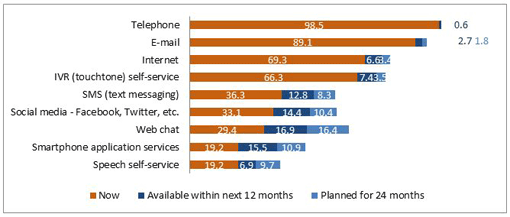
In 2011, 18.6% of participants reported using social media channels and this has rocketed to 33.1% in 2012. There have also been notable increases in the use of web chat and IVR self-service, and one in five contact centres are managing smartphone application services. The role of the human agent will have to change over the coming two to three years. Multi-channel enabled and multi-skilled agents are definitely going to become the norm; it’s just depends on how quickly organisations can facilitate this evolution.
Customers requiring a new insurance policy can search online during their lunch hour or during their commute to find prices. They may post a Facebook comment requesting guidance from their extended networks, or they may even tweet details of an organisation that’s failing to respond quickly enough. The possibilities just keep growing.
The big question now is how quickly organisations can facilitate this evolution. Adds McNair: “The challenge is considerable and the starting point is weak. Some 54.5% of providers that participated in the contact centre research said their existing contact centres are still learning and developing their traditional service channel capabilities, while only 6.7% believe their contact centres are highly advanced.”

Andrew McNair
“These numbers are actually going in the wrong direction – and getting worse – as businesses struggle to keep pace with increasing technology demands.” There’s a risk that consumers receive a wider choice for their basic wants, but that expectations for their more complex requirements are falsely set and not accommodated unless the agent role can keep pace with and properly support the automation.
Meanwhile, 63.3% of the organisations that participated in the research acknowledged that contact centre / customer care is deemed a competitive differentiator, with a further 17.3% stating they had good intentions.
But, explains McNair, organisations still need agents in their contact centres. “While it’s true that the majority of basic transactions are now accommodated via self-help options such as the web or interactive voice response, contact centre agents will play a critical role in managing more complex enquires. That’s because agents will need to support the contact centre’s technology choices and pick up some of the initial slack that may be the result of processes that haven’t caught up.”

Jo Robinson has worked at Call Center Helper since 2007. She started off as News Editor and is currently Operations Manager. Jo quality checks a large number of the articles on Call Centre Helper, along with caring for our customers, managing the eblast programme and sponsorship of our annual benchmarking survey.
Connect with Jo on LinkedIn
Read more by Jo Robinson
The Latest Customer Contact Research, Reports and White Papers straight to your inbox!
Get the latest insights from Call Centre Helper by signing up for our email content.
Close


24th September 2025
From Insight to Impact: The Next Era of CX and AI Leadership – Webinar

