
The Largest Online Community for Contact Centre Professionals


The Largest Online Community for Contact Centre Professionals
 Close
Close




Published On: 6th Aug 2026 06:15
This article contains the extracted Customer and Contact Centre Trends Chapter of our ‘What Contact Centres Are Doing Right Now’ 2020 survey report, which was sponsored by Jacada.
The customer trend which is having the biggest impact on the contact centre industry is that customers are becoming more demanding – according to 37.2% of our readers.
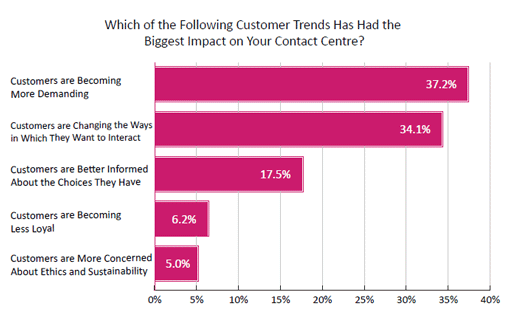
While customer expectations seemed to drop in the spring, when contact centres were rushing into remote working, that patience seems to have run out, and a more demanding customer is something that contact centres must adapt to quickly – even when running a makeshift operation.
Yet contact centres aren’t having to work harder just to meet basic customer expectations, they also have to do so to secure customer loyalty. This is another trend that is impacting contact centres, with 6.2% reporting it to be the biggest trend that they must contend with.
Long gone are the days when the contact centre only had to manage voice channels and emails. Customers’ communication habits are changing, and this is having a huge impact on contact centres.
This was the second major trend causing a huge impact across the industry, with over a third of survey participants (34.1%) telling us it was the biggest customer trend impacting their organization.
New channels bring serious people, process and technology considerations – so the increased prominence of messaging apps, video and even voice assistants is giving contact centres a lot to think about.
Young agents are generally not as inclined to just show up at work and get on with it. They want to enjoy their time at work and to feel that the work they do matters.
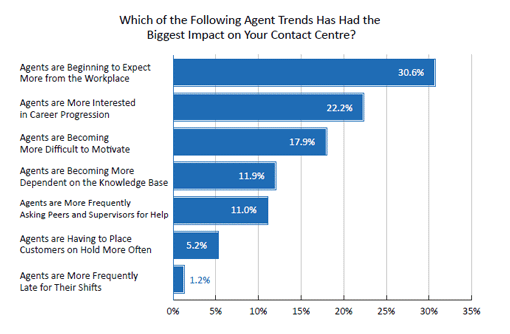
This is a good thing, because happy agents are normally more productive agents, but it does leave agents expecting more from their workplace. This is the biggest agent-related trend in 30.6% of contact centres.
To get ahead of this trend, it is important to give agents the tools that they need, demonstrate respect and show that you value the work they do. Doing this well will involve big changes to the traditional make-up of the call centre.
Few agents start working in the contact centre expecting to stay in that position until they retire. This makes career progression the second biggest trend impacting call centres.
It is becoming harder for contact centres to keep hold of their brightest talent, and those that do will likely spend time with agents, mapping out a progression pathway for them within the company.
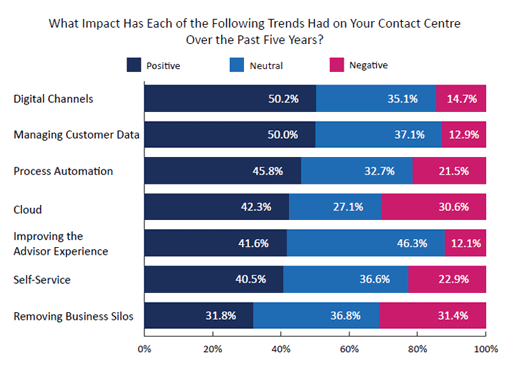
Unsurprisingly, the digital revolution and the prevalence of new digital channels has had a high impact on more than half of contact centres over the past five years (50.2%).
But this is not the only major trend relating to processes and technology that has proved to be a disruptive force amongst the contact centre industry.
For example, managing data (50.0%) and process automation (45.8%) are also proving to be sources of hard work for contact centres. However, all of these trends can make a big difference to customer and agent experience – so hopefully it’s all paying off.
One area which has had a high impact on contact centres – but not as high as expected – is removing business silos, which features at the bottom of our chart.
Most of our contact centre professionals are predicting that voice contacts will drop below 50% of all total contacts within five years – but we are definitely not there yet.
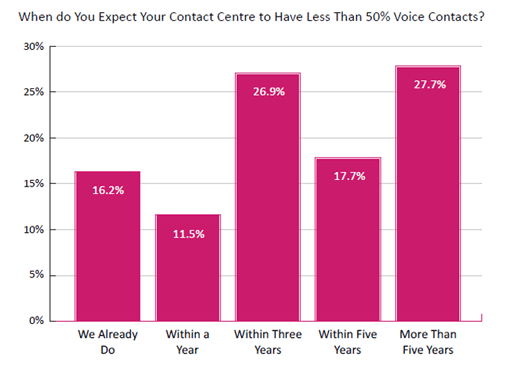
While there has been a lot of hype around digital channels like live chat, messaging apps and social media – amongst others – only in 16.2% of contact centres do total digital contacts exceed voice contacts.
However, another 11.5% of contact centres are expected to get to that point by autumn 2021 and a further 26.9% of contact centres will likely reach that point by 2024.
Even by this point, however, voice will likely be the go-to channel – as most of us, no matter what generation we are in, like human support when a problem is complex and emotional.
As far as digital channels go, according to our results, we must remember that it’s a marathon, not a sprint.
An overwhelming 91.6% of our industry professionals believe (i.e. either “strongly agree” or “agree”) that the role of the call centre agent will require a much-enhanced skill set in ten years’ time.
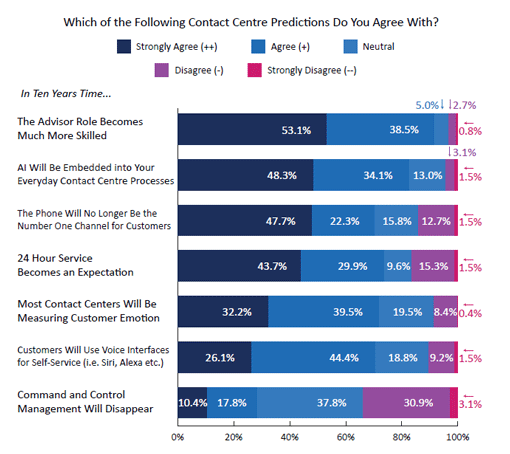
A further 82.4% of contact centres believe that AI will be embedded into everyday contact centre processes within that time period.
According to these predictions, it seems as though contact centre leaders will spend a great deal of time over the next ten years considering how AI can support agents and, potentially, vice versa.
The one prediction that most of our survey respondents did not necessarily agree with was that command-and-control management will disappear.
In fact, more respondents disagreed with this statement than agreed with it.
Follow this link to view the full Call Centre Helper survey report ‘What Contact Centres Are Doing Right Now‘.
Alternatively if you are interested in a specific chapter read one of these extracts next:
This survey was done in partnership with Business Systems, Jacada, Voci Technologies and Vonage.
To download the full copies of our ‘What Contact Centres Are Doing Right Now’ survey reports follow the links below:
You can also download the full copies of our ‘Is Your Contact Centre Delivering Exceptional Customer Service?’ survey reports by following the links below:
Reviewed by: Jo Robinson

The Latest Customer Contact Research, Reports and White Papers straight to your inbox!
Get the latest insights from Call Centre Helper by signing up for our email content.
Close