The Largest Online Community for Contact Centre Professionals


The Largest Online Community for Contact Centre Professionals
 Close
Close




Published On: 6th Aug 2026 08:00
We define customer data analysis, before sharing how it can be used as a tool to improve performance across the whole organization.
Customer data analysis is the process of looking for patterns in your customer data, with the intention of improving…
Customer data analysis is the process of looking for patterns in your customer data, with the intention of improving a certain part of your organization’s performance.
This last part is key, according to Duncan White, the Managing Director of horizon2.
“Analysis by itself doesn’t deliver any improvement. Just because you can see an organizational improvement opportunity, that doesn’t mean that it is being delivered,” says Duncan.
So, as we go forward with our customer data analysis, we should remember these three golden rules, as recommended by Duncan:
This last point is particularly key, because if we are going to analyse anything, we’ve got to have a performance initiative on the back of it.
Remember: “You don’t fatten a pig just by weighing it.”
Making improvements based on good customer data analysis has a whole range of benefits.
Of course it depends very much on what we analyse, but five classic benefits are:
Find out how to create an effective proactive customer service strategy in our article: What Is Proactive Customer Service? With a Definition, Examples and Key Challenges
In our research we have found three key subsets of customer data which can be analysed for different purposes. These are:
Personal data is often the data that we collect when the customer first starts doing business with us. This includes things like:
We can gather more personal information through the use of website cookies and IP addresses.
We can also collect data like this by using device IDs, while we can gather more personal information through the use of website cookies and IP addresses.
The benefit of capturing this information is simple; it allows us to recognize individual customers and therefore offer a personalized service.
This data can be used to create customer personas and also to see how engagement varies by things like age and location.
Engagement data tells us how customers are interacting with our brand and helps us to uncover different patterns in how customers interact with us, right across their journey.
So, by collecting engagement data, we are gathering insights, such as:
We can also do things like use heat maps on our website to identify how customers are engaging with us online and where they are struggling – if we have an online improvement initiative to back it up.
By collecting engagement data like this, we will have so many things to analyse in terms of customer behaviour.
We can track how customers react to a new promotion, a new contact centre channel or any other changes within the customer journey.
For example, we can track how customers react to a new promotion, a new contact centre channel or any other changes within the customer journey. We can also see how they are using our products.
Sentiment data gives us insights into the feelings and emotions of our customers. This data is usually gathered through contact centre surveys and analytics.
With this in mind, when we collect sentiment data, we are looking at things like:
Sentiment data helps us to add context to engagement data. For example, pairing advert engagement data and customer satisfaction will tell us who to send a certain marketing campaign to.
Also, by collecting insights into how customers are feeling, simple analysis will tell us who is likely to churn, so we can take action to ‘save’ them. This can have a big impact on revenues.
Another benefit is that sentiment data will really help to show us the points in our customer journey that help us to stand out from the crowd.
There are hundreds of ways to collect data, whether that’s through surveys, analytics tools or adding steps into the customer journey where customers have to share their data with us.
But, before we get into that, we first want to consider:
Of course, there are other important things to consider, such as whether we are being compliant in collecting data, but these are really the key questions that we need to think about to put together a highly beneficial strategy for customer data analysis.

Brent Bischoff
The first question of where to collect the data is particularly important, as Brent Bischoff, a cloud and data service consultant at Business Systems, says: “First, you need to look at all the places your customers are likely to go, and see if you can gain customer intelligence there.”
This is an important point to keep in mind as we present the following examples of data collection.
For more examples of contact centre systems, read our article: Call Centre Software: What Should You Be Looking Out For?
To be successful in our customer data analysis, the data needs to be accurate. So we need to have a plan for data cleaning and validation. This may follow the process below:
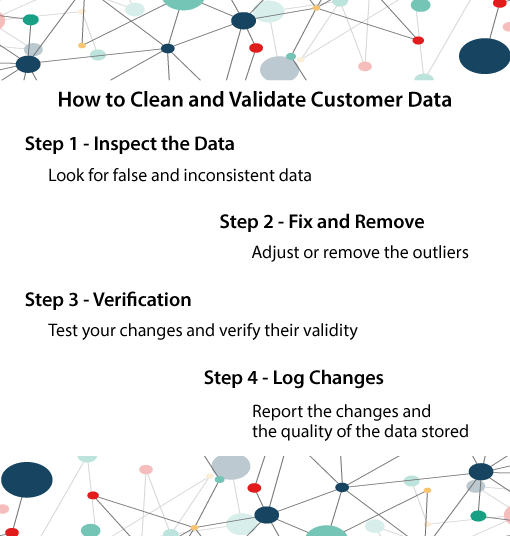
No matter how we collect data, we will always run into outliers – we just need to know what and when to remove certain data points.

Dave Appleby
As contact centre expert Dave Appleby tells us: “The key is to analyse the outliers that we remove and to also look for patterns within our data anomalies that might just be becoming business as usual.”
Another key consideration when cleaning data is not only what to remove, which is the more obvious part, but also what to add back.
We can’t add a zero into a complex set of data, as that seriously impacts any calculations that we make from the data. So maybe we can add a mean figure or instead use a second or third deviation of the figure?
It will all depend on what we plan to do with the data and the techniques that we use to analyse it…
Now we have gathered and cleaned our data, we can start analysing it. Here are five customer data analysis techniques that will help us on our way.
Find more techniques for analysing data in our article: 25 Tips for Effective Data Visualization
Now we have covered the essentials of customer data analysis, we can share some key examples of what customer data to analyse and how to make organizational improvements on the back of that.
Most people don’t like to phone into the contact centre, and unless talking to customers is a key competitive advantage for us, we should be seeking every opportunity not to talk to our customers.
Understanding why people are calling, when they’re contacting us, and how we’re handling that volume can be a great place to start.
This is where analysing customer demand comes in. Understanding why people are calling, when they’re contacting us, and how we’re handling that volume can be a great place to start.
We will find some very interesting things by doing this and potentially save an awful lot of resource.
In fact, one contact centre – according to Duncan White – had to double in size from 350 FTE to 700 FTE in a nine-month period because they didn’t understand why customers were calling – yet analysing customer demand would have given them a lot of the answers.
The problem of analysing customer effort in some contact centres is that we have to decide what constitutes customer effort in our organization. Is it:
The key thing here is that it needs to be something that can be recorded and measured accurately – with little effort.
Why is measuring customer effort like this so important? Well, it has a very close relationship with customer satisfaction, as highlighted in the Harvard Business Review’s well-known article: “Stop Trying to Delight Your Customers“.
Why is measuring customer effort like this so important? Well, it has a very close relationship with customer satisfaction…
This article revealed that when we lower effort, we can improve satisfaction, and it also proposed an interesting way to do this, through analysing customer data and improving. They called it a “no audit”.
In the article, one organization analysed how many times contact centre advisors were forced to say “no” to a customer, for any reason.
This led to them identifying many outdated processes and policies, which they were able to change in order to massively reduce effort. It also saved them a million dollars over the first year.
Judgemental heuristics is a framework or shortcut to understanding how people judge an experience.
One key aspect of judgemental heuristics is recognizing that one part of an experience is much more memorable than others.

Duncan White
As Duncan tells us: “Our analyses have always found that really high levels of customer experience are always correlated with a combination of task resolution, customer effort and judgemental heuristics.”
“So it all boils down to: did you resolve the customer’s problem? How easy did you make it for the customer? As well as how did you make them feel and how did you leave them feeling?”
Therefore we should be analysing touchpoints in our customer experience to check that we are starting and ending a customer journey on a memorable note. We also want a memorable part in the middle, in line with the peak–end rule.
To find out more about the peak–end rule, read our article: 7 Steps to Evoke the Emotions You Want From Your Customers
Customer journeys are the aggregation of all the customer’s activity that we need to understand, not just the point or the “silo” that we are responsible for.
There can be great value, in fact, in analysing how customers move from one touchpoint to another.
Let’s take a contact centre only example. Looking at the path of a contact through the contact centre and through departments can provide multiple insights into where bottlenecks are and where customers “fall out” of a channel.
Another way we can analyse the customer journey and improve is to find out which channels our customers prefer to use for each type of interaction with our company.

Frank Sherlock
“Understand why people use each channel. You can then provide the right resources to meet those needs,” adds Frank Sherlock, VP International at CallMiner.
“Also, you can point them in the right direction to use the right channel at the right time, resulting in happier customers, happier agents and reduced customer churn.”
Find out more about customer journey analytics, by reading our article: What Is Customer Journey Analytics and How Can It Benefit Your Organization?
The nuts and bolts of customer data analysis is context data, which provides additional insight into an event’s, individual’s or product’s performance.
This is all about linking the context to the content. We don’t look at context data to find out what is going on, but to find out why.
For example, if we identify a trend where a certain contact type is always being transferred, we look at context data to determine:
Another example, in terms of the wider customer journey, is if we notice that sales in one location have stalled, we can then use context data to find out if it is because of competitor activity, less foot traffic in the area or something else.
We can then use context data to better understand the problem and make more informed decisions to increase revenues and improve customer experience.
Customer data analysis involves collecting, cleaning and grouping customer data, before looking for trends and key areas in which to improve organizational performance.
There are many different types of customer data to collect, including personal data, engagement data and sentiment data.
The key to deciding what to analyse is to have a purpose before we start our analysis. This purpose must be to improve in one area.
Just remember, if we are not going to find the time to improve, what’s the point in doing the analysis?
For more on customer analysis in the contact centre read our articles:

The Latest Customer Contact Research, Reports and White Papers straight to your inbox!
Get the latest insights from Call Centre Helper by signing up for our email content.
Close