
The Largest Online Community for Contact Centre Professionals


The Largest Online Community for Contact Centre Professionals
 Close
Close



Published On: 5th Aug 2026 08:00
If your agents are engaged, your tools are decent, and your intent is right, but the results still fall short – you probably have a process problem in your contact centre! And no amount of effort can fix what is structurally flawed.
So, what can you do about it? Here, experienced complaints manager Stephen Miller explains how to start identifying and repairing your broken processes.
A broken process isn’t always loud or obvious. Sometimes it looks like a silent delay. Other times it hides in agent workarounds or customer confusion.
For contact centre professionals, a broken process is anything that gets in the way of smooth, repeatable, and effective service delivery.
These issues chip away at trust – both with customers and internally. They create friction, increase handling time, and damage your team’s confidence.
Common culprits include inefficient data capture, unclear escalation paths, and mismatched customer journeys across channels.
In the digital space, silent chat abandonment and poorly routed messages add new layers of complexity.
Quite simply, if your advisors are inventing their own ways to make things work, your process is not working!
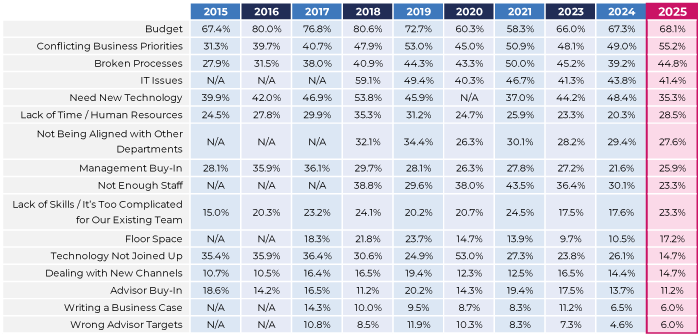
It doesn’t stop there. As seen in the annual ‘CCH Benchmark Report: What’s Happening with Customer Contact in 2025?’, 44% of contact centre professionals even say broken processes stop them from running their ideal contact centre:
Spotting a broken process starts with listening. Not just to what customers say, but to what advisors do to get things done.
These are more than service annoyances; they are warning signs of structural problems.
You can also use quality assurance (QA) to do more than score advisor performance – and analyse interaction patterns too. For example, asking where does the conversation break down? Where are promises made but not fulfilled?
Then, use speech and text analytics to identify repeated terms like “still waiting”, “called before”, or “transferred again”.
Also look for tech signals: agents switching between screens, copying text from other systems, or using unapproved templates, as these all suggest they’re compensating for process gaps.
Silent abandonment is an increasingly relevant signal. If customers drop out of chats or digital conversations without resolution, it might not be disinterest – it could be fatigue with a poor process that wastes their time.
To really understand what your customers are going through and where you can make the biggest difference, read our article: 10 Ways to Go Deeper With Customer Journey Mapping
Once you know something is broken, the next step is to map it. Service blueprinting helps you visualize every step a customer and advisor takes in a typical interaction. This includes the visible touchpoints and the behind-the-scenes operations that support them.
By blueprinting your processes, you reveal how many hands a contact passes through, where the delays live, and which steps add no value.
For example, a billing query might touch five different teams, each making updates in a different system. Or a complaint might sit untouched in a shared inbox because no team believes it’s theirs to resolve.
Ask bold questions: Why do we do this? What if we didn’t? Who actually benefits from this step?
This kind of mapping allows you to streamline workflows, reassign responsibility, and reimagine the flow in a way that makes sense for both the customer and the advisor.
Fixing a process isn’t about finding blame – it’s about finding clarity. Use tools like the Five Whys to get beyond symptoms and reach root causes.
A high volume of complaint calls might be driven by unclear bills. But what causes the billing confusion? A formatting issue? A lack of notification? A misalignment between product and billing systems?
Once you understand the root cause, the next step is ownership. Use Peter Massey’s Inside-Outside-Policy framework to determine where the issue lives.
Is it a frontline (inside) problem, a back-office (outside) dependency, or a policy issue that needs rewriting? Without this clarity, improvement efforts will fizzle out or be misdirected.
Cross-functional collaboration is key. Broken processes often span teams, systems, or even business units. Fixes require shared understanding, aligned incentives, and a clear roadmap.
The best solutions come from those closest to the problem. Include advisors in the fix. Their insights are too valuable to ignore.
Not every process failure needs a six-month project. Some can be resolved with quick, practical changes that make an immediate impact. Start with pain points that frustrate both customers and advisors.
Above all, resist the temptation to digitize a bad process. Automating broken steps will only make failure faster and more expensive. Fix first, then optimize.
For top advice on common customer service mistakes, read our article: Are You Falling Into These Customer Service Traps?
Fixing broken processes can’t be a one-off campaign. It has to become part of how your contact centre operates.
That means creating a culture where identifying broken processes is encouraged, not penalized. Frontline advisors must feel safe to say “This doesn’t work.”
Continuous improvement thrives on rhythm. Schedule process reviews. Revisit service blueprints. Let team leaders share quick wins in leadership huddles. Normalize the idea that process change is part of the job, not a separate initiative.
If you are looking for advice to embed continuous improvement in your contact centre, read our article: Make Continuous Improvement Part of Your DNA
Without evidence, process improvements rarely gain traction. Track the right before-and-after metrics to demonstrate success.
Did average handle time go down? Did complaints on a specific issue drop? Are fewer customers being transferred? Is first contact resolution improving?
Tag root causes in QA reviews to build a pattern library. Use dashboards to highlight trends across teams and channels. Monitor not just what got fixed, but what stayed fixed. Recurring issues suggest the fix didn’t address the real root or wasn’t embedded properly.
Share your results. Present fixes as wins to leadership, complete with impact data. This builds momentum, justifies further investment, and shows your team that their feedback matters. Change becomes sustainable when its value is visible.

Broken processes don’t just frustrate customers – they erode advisor morale, inflate costs, and limit potential. But they are also the clearest opportunity for transformation.
By identifying the cracks, mapping the journey, and empowering teams to fix what’s failing, you move closer to the dream contact centre. The one where customers stay, teams thrive, and operations run on rhythm, not rescue.
So, ask yourself: what’s the one broken process your team is tolerating today – and what would change if you stopped accepting it tomorrow?
Written by: Stephen Miller, Complaints Manager at Vitality
For more information on broken processes in contact centres, read these articles next:
Reviewed by: Xander Freeman

The Latest Customer Contact Research, Reports and White Papers straight to your inbox!
Get the latest insights from Call Centre Helper by signing up for our email content.
Close