The Largest Online Community for Contact Centre Professionals


The Largest Online Community for Contact Centre Professionals
 Close
Close



Published On: 5th Aug 2026 08:00
Olena asked our LinkedIn Community ‘What KPI is the most valuable in improving NPS/CSAT?’
1,394 industry professionals responded, and we wanted to share the results and the key comments.
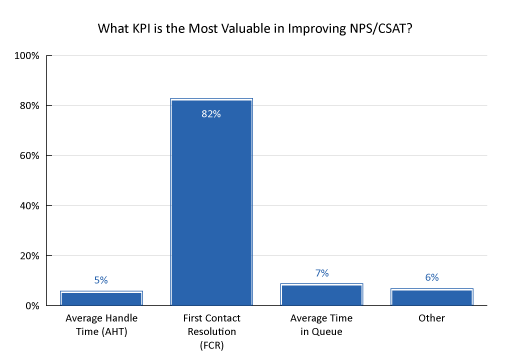
| KPI to Improve NPS / CSAT | Response % |
|---|---|
| Average Handle Time (AHT) | 5% |
| First Call Resolution (FCR) | 82% |
| Average Time in Queue | 7% |
| Other | 6% |
First Call Resolution (FCR) was the top choice, with 82% of respondents selecting this as the most valuable KPI for improving NPS/CSAT.
This suggests that companies understand that customers are prioritizing having their issue resolved in the first contact and are using KPIs to achieve the expected levels of customer experience.
Average Handle Time (AHT) and Average Time in Queue (ATQ) were far behind, with 5% and 7% of respondents respectively selecting this as the most valuable KPI, and 6% of industry professionals selected ‘Other’.
The results were interesting, but not altogether surprising. What stood out was the discussion this question provoked.
Several respondents added additional details in the comments and explained why they chose the option they did. We have gone through and selected the top responses:
We’ve run several sweet-spot analyses for clients. We have found that FCR is the most robust correlator to NPS… and for each client, the optimum for AHT ranges, where this happens, differs from customer to customer as well as the specific call driver for a customer.
Contributed by: Werner
While reduced AHT and waiting time will please the customer, the ultimate goal is resolution of the issue.
Usually, customers tolerate waiting if they know they will be helped once they get through and would prefer the call to take longer if it means their query is answered.
Contributed by: Helen
Hands down FCR, and it’s not even close. AHT, ACW, and all the other metrics don’t matter a bit if you can’t provide FCR or at least a true expectation of resolution time.
Then a follow-up call regardless of whether it’s resolved, to update the client at the quoted time is paramount.
It’s not rocket science, but too many leaders focus on AHT and OCW without resolution.
Contributed by: Walt
Never met a customer who was concerned about AHT and other similar internal business measures.
Every customer that I have ever consulted about satisfaction was interested in AFCR – Accurate First Contact Resolution. Most old-school contact centre measures are used for internal cost control purposes.
Contributed by: Doug L.
FCR followed closely by ASA (average speed to answer).
If someone waits 20 mins to get their call answered, they will still be a neutral to light dissatisfied even if the issue is resolved.
Contributed by: Dennis
Answer rates. First step is getting the customer to answer your call. Helping your customer trust it’s you when you call seems like a huge battle on answer rates
Contributed by: Darcy
Attitude of handling customers
Contributed by: Varughese
Net easy score – how easy is it to deal with the organization.
Contributed by: Allan
While FCR is a great tool, I find that VOC (Voice of the Customer) metrics like Sentiment and Tone are more closely aligned to Customer Satisfaction. Put them together, measure consistently AND elevate them as KPIs with your leaders is a winning plan in my experience.
Contributed by: Genese
FCR in my opinion, albeit within reasonable answer times (indicated by abandonment rate).
AHT is meaningless for the customer in isolation and often driven by complexity. If it leads to FCR, then customers are often more than happy for it to take longer so long as it’s resolved there and then.
Wait time is also meaningless in isolation – as there’s nothing customer-centric about having to wait 10 seconds in a queue but then having to call back 8 times!
Plus, wait times don’t usually consider the treacherous IVR journey that procedes going into the queue.
Contributed by: Mike J.
I have always found that FCR drives customer satisfaction (NPS) best. All the other metrics also play an important role, but:
At the end of the day, customers only want to hear that you understand their query and you will be able to assist them to resolve it.
Old or not, these are still fundamental metrics that run a call centre.
Contributed by: Lesego
I feel like CES (Customer Effort Score) is a much more valuable KPI but harder to measure. It captures the Time in Queue (5 min is more effort than 3), FCR (2x calling is more effort than 1) and AHT!
It can also measure how the customer experiences the service, how easy something is to find online (FAQ, website, call-avoidance strategies like proactive service contacts)
Talking to the customer is the key point in all of this. Some people don’t mind waiting in line if the person on the other side gives them an incredible customer service.
Contributed by: Jéroen
Not a KPI as such, but I think empathy is the most valuable entity for NPS/CSAT improvement.
Contributed by: Scott
AHT is for the company.
FCR and ATQ is what matters when it comes to customer satisfaction.
Of course, this is not the least.
Contributed by: Jayarous
Higher AHT OR even a long hold but a professional attitude and FCR is the king of customer experience!!
Contributed by: karan
It’s a mix. First time resolution is for sure as important as time to respond, but more important is proactive follow-up.
It makes no sense to give an answer in 2 hours but the customer needs to come back in 2 days to ask for an update …..
Contributed by: Ralf
AHT is really an anachronism in this day and age. From a caller’s viewpoint, it may have been important for quick transactional issues, but they are largely dealt with via digital channels now.
Any company that is hanging onto AHT is likely only interested in an outmoded view of the contact centre as a cost centre.
Clearly, for a caller FCR is prime, but again CSAT will be impacted positively or negatively by ATQ.
Other? Maybe a qualitative measure based upon agent friendliness and like-mindedness, last agent routing based upon profiling or customer feedback could definitely help.
Contributed by: Lee E
AHT isn’t important to the customer. Some businesses fail to take the bold leap to be most focused on resolution rather than AHT.
Most time an agent is so worried about getting the customer off the phone that the issue isn’t really addressed. However, you can take 20 mins to resolve many issues or concerns and never get another call for months.
Or you can rush the customer off the phone in the 3-5 mins and the issue isn’t really resolved or they call with another issue that they didn’t get time to ask. So now we have repeat callers.
Contributed by: Tenisha
We have tried a post-call survey at the end of every incoming call – higher participation and better scores are a better judge of customer happiness, in my opinion.
Contributed by: Abida
On the flip side, a long wait time may demonstrate a high level of customer dissatisfaction and a lack of investment in adequate resources.
In order to be successful at improving NPS/CSAT scores, it is imperative to not only be able to view average time in queue via control/admin panels, but to create live alerts which get sent to the relevant internal company employees who can escalate issues quickly to help retain customers and reduce churn.
In general, all of the below lead to increased levels of customer success and maximum utilization of contact centre reps (less drain on resources > increased profits)
TRACK AND CREATE AUTOMATED ALERT NOTIFICATIONS!
Contributed by: Navdip
FCR is the bedrock of a successful contact centre. Strong call routing and automation combined with an empowered FCR-focused colleague will make a significant difference.
It’s not the only lever but it’s a really important one.
Contributed by: Adam
It is also worth noting that with only three metrics to choose from and ‘other’ being the fourth option, the options available to respondents were limited.
FCR clearly dominated the results as the most valuable metric, and if the respondents did not agree, they could have picked ‘other’. However, some of the respondents questioned the metric options provided:
You can’t drive without having fuel meter, speed meter, heat meter, and so on, right?
The same way with CX: you can’t manage CX without FCR, AHT, ATQ, etc. It is a symbiosis of KPIs.
Contributed by: Leonardo
NPS is the best measure for NPS, and CSAT is a smoke screen because you’re hearing from <5% of your customers, and if having a good experience with your support team is your goal for measurable performance, you’re probably chasing the wrong metric.
Contributed by: Steve
I think these are outdated KPIs.
Voice should be the last resort for a customer. Who wants to talk to an agent?
Designing intelligent, self-service journeys / integrated multichannel should take priority, and any KPI that measures customer effort (CES) to resolve their issue would be recommended.
Contributed by: Babak
None of them.
These lead to unhappiness. (Kano model)
You need to identify correlating and actionable KPIs that measure satisfaction/happiness throughout the customer journey.
Contributed by: Sabri
I find it ironic and concerning that none of those measures actually measures customer happiness!
Contributed by: Keith
Source: Poll conducted in our LinkedIn Community Sample size – 1,394 Date: 2022
Reviewed by: Jo Robinson

The Latest Customer Contact Research, Reports and White Papers straight to your inbox!
Get the latest insights from Call Centre Helper by signing up for our email content.
Close