
The Largest Online Community for Contact Centre Professionals


The Largest Online Community for Contact Centre Professionals
 Close
Close




Published On: 6th Aug 2026 08:00
We share a list of best practices for how to run a COVID-safe hybrid contact centre.
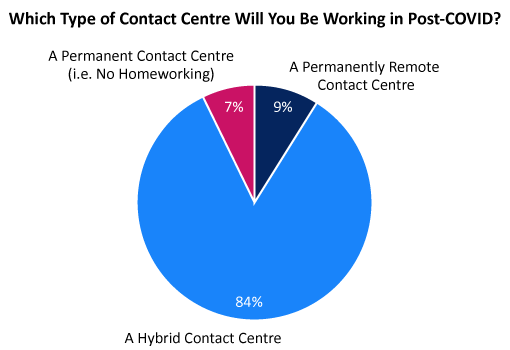
While remote working has become the norm, very few contact centres are planning to stick to a fully remote contact centre, post COVID-19.
In fact, most plan to use a blend of office-based and remote agents, as can be seen in the chart below.
While there are many benefits to remote working, this research shows that contact centres have also uncovered many drawbacks, which may include:
If you are one such contact centre and considering moving back to a COVID-safe contact centre in the current climate, here are some of the precautions that you should be looking to take.
However, please do keep an eye on the government guidelines as well, as they do change frequently.
One key health and safety consideration is to stagger start times to prevent congestion in reception spaces. This is an area in which your planning team can really shine.
Yet there are many more health and safety considerations to make. For example, you could also consider the following processes and procedures:
While the health and safety tips above are all important, there are more safety practices that you should follow, to align with government guidelines.
It’s also important to make changes to other facilities within the contact centre, including:
While you can test and test your hybrid strategy, it is difficult to get things exactly right from the get-go.
With that in mind, create a timeline for moving back to the office. It could look something like this:
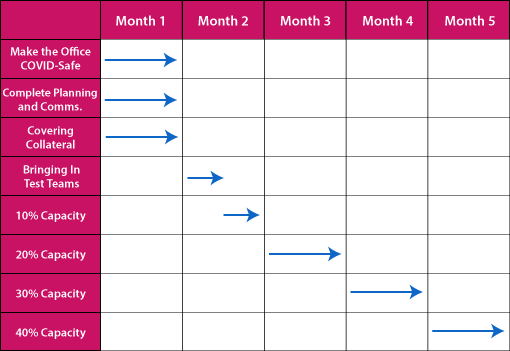
As you can see, it might just take a month and a half of planning and preparing to move just 10% of your team back to the contact centre.
Why? Well, there will likely be a need to run through activities like the following:
It is likely that only after working through these bullet points will you be ready to bring back your team, in small groups.
When you bring back people into the office, make sure their team leaders are there to support them through the new systems and address any safety concerns.
With the scary news reports and first-hand stories of how COVID-19 is impacting people’s lives, many of your team may feel uneasy about moving back to the office.
In fact, we know of one contact centre in which an advisor had to be escorted to work by her husband, as she was so scared to return to the office.
Having leaders there to reassure agents is therefore important, so they can have open discussions with each advisor and set new expectations.
Leaders can also help remind advisors of the new measures if they slip back into pre-COVID routines, which can be easy to do when moving back into an old, familiar environment.
If you’re looking to move back to the contact centre, one of your primary reasons will likely be to improve the well-being of your team. After all, 2020 has not been the best year for everybody’s mental health!
With that in mind, you want to keep the social aspect of working in the contact centre, while staying safe. So instead of “social distancing”, think “physical distancing”.
Nobody wants to sit at their desk all day. Advisors should be allowed to go to breakrooms and interact with friends – as long as they keep two metres apart from each other (and everybody else).
However, it is important to ensure that breakrooms do not exceed a “capacity limit” and that they are cleaned diligently.
To avoid queues for the appliances and hordes of people moving about close to one another, many contact centres will decide that closing their shared kitchen areas is the safest thing to do.
But be prepared for some backlash, as this is unlikely to be a popular decision, as the team will miss their old foods and drinks.
So why not introduce a “tea trolley” service – with all of the team’s favourite treats.
It may also be a good idea to include complimentary bottled water, hot drinks, fruit and health snacks – which has also been great in accommodating healthy lifestyles.
Before you bring staff back into the contact centre, you need to set expectations as to what their new working day will look like. This is the safest thing to do, will avoid confusion and reassure returning advisors that the contact centre is a “safe space”.
So, when you bring back your first advisors in test teams, invite some to have their journeys through the new contact centre filmed.
This can include advisors being recorded as they check in, have their temperature taken by the thermal cameras and use the one-way system, etc.
Being a part of these videos is not only fun for the agent, but – as you can proliferate these videos around your internal communications systems – other advisors can familiarize themselves with the “new” contact centre.
Many of you will already have e-learning as part of your team development programmes. This can be expanded to include an induction to your new COVID-safe building, when moving back to the office.
To be more exact, you can use online learning to inform staff – as well as through video – of the changes that you have made to the space that they are oh-so familiar with.
Other features that you may want to include in your online training include:
This online learning was so crucial to one contact centre that moved back to a COVID-safe environment that they cancelled all building passes at the start of lockdown. They were only reactivated once the team member completed this crucial piece of e-learning.
For more advice on running a great e-learning portal for your contact centre, read our article: The Best Uses for e-Learning in the Contact Centre
If you switch to a hybrid contact centre, it’s good to keep remote agents in touch with office agents, to foster a strong team relationship.
After all, employees will miss out on many spontaneous interactions with each other – even if they are working in the “physically distanced” contact centre.
Having these interactions and other forms of social support is vital for employee well-being and long-term team engagement.
So, set aside more time for having conversations with your team, while helping to arrange virtual coffee breaks and quizzes. This is important to help the team maintain meaningful connections with their colleagues.
For more on keeping remote workers happy and motivated, read our article: 11 Team Engagement Ideas to Inspire Your Remote Workers
Reviewed by: Robyn Coppell

The Latest Customer Contact Research, Reports and White Papers straight to your inbox!
Get the latest insights from Call Centre Helper by signing up for our email content.
Close